Productbeschrijving
|
Gear Types |
spur gear, helical gear, internal spur gear, ring gear, straight/spiral bevel gear, hypoid gear, CZPT wheel & pinion, gear shaft, worm gear & worm shaft, spline shaft & bushing, etc. |
|||
|
Gear Material |
Steel: C45, 40Cr, 42CrMo, 20CrMnTi, 20CrNiMo, etc.; Aluminum Alloy: 2571, 7075, etc.; Brass, Bronze, Aluminum Brone, etc.; POM Plastic, MC901 Nylon, etc.; |
|||
|
Processing |
blank turning; tooth hobbing, broaching, milling, shaping, etc.; bore honing; tooth shaving, tooth grinding |
|||
|
Heat Treating
|
tooth induction quenching, vacuum quenching, etc. for 45-50HRC; carburizing for 56-62 HRC; nitriding, carbon-nitriding for gears required abrision resistan; |
|||
|
Application |
Automotive, Agricultural, Electronic, industrial, Medical, Defense, Off-highway, etc. |
|||
Quality control system:Our company carries out quality control in each link, the raw material needs to have the trace element assay report, the forging blank size inspection and the density inspection, each production process has the inspection worker to inspect, the metallographic organization after the heat treatment and the hardness inspection and so on.
FAQ:
1. Q: What information should we provide before placing an order?
A: a) Ditailed drawings if possible. b) Samples without Drawings. c) Purchase quantity. d) Other special requirements.
2. Q: Are you a factory or a trading company?
A: We are a professional group company with more than 20 years of experience.
3. Q: Can you customize according to our requirements?
A: Yes, we can design non-standard products according to customers’ special requirements.
4. Q: How long is the delivery date?
A: 30 – 45 business days, according to quantity.
5. Q: What are your payment terms?
A: 30% prepayment, 70% paid before shipment.
/* January 22, 2571 19:08:37 */!function(){function s(e,r){var a,o={};try{e&&e.split(“,”).forEach(function(e,t){e&&(a=e.match(/(.*?):(.*)$/))&&1
| After-sales Service: | 1year |
|---|---|
| Condition: | New |
| Color: | Black |
| Certification: | ISO |
| Type: | 1 |
| Application Brand: | 2 |
| Samples: |
US$ 80/Set
1 Set(Min.Order) | |
|---|
| Customization: |
Available
| Customized Request |
|---|
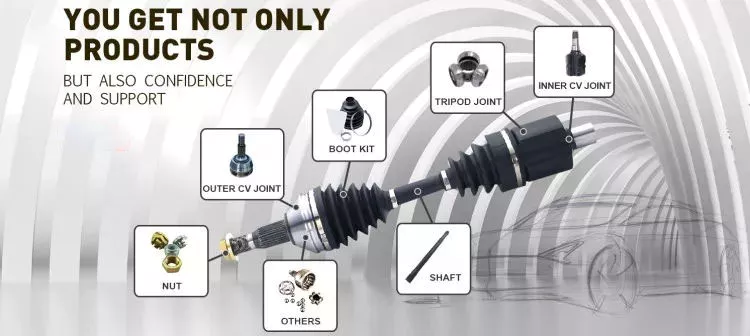
How do drive shafts ensure efficient power transfer while maintaining balance?
Drive shafts employ various mechanisms to ensure efficient power transfer while maintaining balance. Efficient power transfer refers to the ability of the drive shaft to transmit rotational power from the source (such as an engine) to the driven components (such as wheels or machinery) with minimal energy loss. Balancing, on the other hand, involves minimizing vibrations and eliminating any uneven distribution of mass that can cause disturbances during operation. Here’s an explanation of how drive shafts achieve both efficient power transfer and balance:
1. Material Selection:
The material selection for drive shafts is crucial for maintaining balance and ensuring efficient power transfer. Drive shafts are commonly made from materials such as steel or aluminum alloys, chosen for their strength, stiffness, and durability. These materials have excellent dimensional stability and can withstand the torque loads encountered during operation. By using high-quality materials, drive shafts can minimize deformation, flexing, and imbalances that could compromise power transmission and generate vibrations.
2. Design Considerations:
The design of the drive shaft plays a significant role in both power transfer efficiency and balance. Drive shafts are engineered to have appropriate dimensions, including diameter and wall thickness, to handle the anticipated torque loads without excessive deflection or vibration. The design also considers factors such as the length of the drive shaft, the number and type of joints (such as universal joints or constant velocity joints), and the use of balancing weights. By carefully designing the drive shaft, manufacturers can achieve optimal power transfer efficiency while minimizing the potential for imbalance-induced vibrations.
3. Balancing Techniques:
Balance is crucial for drive shafts as any imbalance can cause vibrations, noise, and accelerated wear. To maintain balance, drive shafts undergo various balancing techniques during the manufacturing process. Static and dynamic balancing methods are employed to ensure that the mass distribution along the drive shaft is uniform. Static balancing involves adding counterweights at specific locations to offset any weight imbalances. Dynamic balancing is performed by spinning the drive shaft at high speeds and measuring any vibrations. If imbalances are detected, additional adjustments are made to achieve a balanced state. These balancing techniques help minimize vibrations and ensure smooth operation of the drive shaft.
4. Universal Joints and Constant Velocity Joints:
Drive shafts often incorporate universal joints (U-joints) or constant velocity (CV) joints to accommodate misalignment and maintain balance during operation. U-joints are flexible joints that allow for angular movement between shafts. They are typically used in applications where the drive shaft operates at varying angles. CV joints, on the other hand, are designed to maintain a constant velocity of rotation and are commonly used in front-wheel-drive vehicles. By incorporating these joints, drive shafts can compensate for misalignment, reduce stress on the shaft, and minimize vibrations that can negatively impact power transfer efficiency and balance.
5. Maintenance and Inspection:
Regular maintenance and inspection of drive shafts are essential for ensuring efficient power transfer and balance. Periodic checks for wear, damage, or misalignment can help identify any issues that may affect the drive shaft’s performance. Lubrication of the joints and proper tightening of fasteners are also critical for maintaining optimal operation. By adhering to recommended maintenance procedures, any imbalances or inefficiencies can be addressed promptly, ensuring continued efficient power transfer and balance.
In summary, drive shafts ensure efficient power transfer while maintaining balance through careful material selection, thoughtful design considerations, balancing techniques, and the incorporation of flexible joints. By optimizing these factors, drive shafts can transmit rotational power smoothly and reliably, minimizing energy losses and vibrations that can impact performance and longevity.

Hoe verbeteren aandrijfassen de prestaties van auto's en vrachtwagens?
Aandrijfassen spelen een belangrijke rol bij het verbeteren van de prestaties van auto's en vrachtwagens. Ze dragen bij aan verschillende aspecten van de voertuigprestaties, waaronder vermogensafgifte, tractie, wegligging en algehele efficiëntie. Hieronder volgt een gedetailleerde uitleg over hoe aandrijfassen de prestaties van auto's en vrachtwagens verbeteren:
1. Stroomvoorziening:
Drive shafts are responsible for transferring power from the engine to the wheels, enabling the vehicle to move forward. By efficiently transmitting power without significant losses, drive shafts ensure that the engine’s power is effectively utilized, resulting in improved acceleration and overall performance. Well-designed drive shafts with minimal power loss contribute to the vehicle’s ability to deliver power to the wheels efficiently.
2. Koppeloverdracht:
Aandrijfassen zorgen voor de overdracht van koppel van de motor naar de wielen. Koppel is de rotatiekracht die het voertuig vooruit drijft. Hoogwaardige aandrijfassen met de juiste koppelomzettingscapaciteiten zorgen ervoor dat het door de motor gegenereerde koppel effectief naar de wielen wordt overgebracht. Dit verbetert het vermogen van het voertuig om snel te accelereren, zware lasten te trekken en steile hellingen te beklimmen, waardoor de algehele prestaties verbeteren.
3. Tractie en stabiliteit:
Aandrijfassen dragen bij aan de tractie en stabiliteit van auto's en vrachtwagens. Ze brengen de kracht over op de wielen, waardoor deze kracht kunnen uitoefenen op het wegdek. Dit zorgt ervoor dat het voertuig grip behoudt, met name tijdens het accelereren of bij het rijden op glad of oneffen terrein. De efficiënte krachtoverbrenging via de aandrijfassen verbetert de stabiliteit van het voertuig door een evenwichtige krachtverdeling over alle wielen te garanderen, wat de controle en het rijgedrag ten goede komt.
4. Bediening en manoeuvreerbaarheid:
Aandrijfassen hebben een grote invloed op de wegligging en wendbaarheid van voertuigen. Ze zorgen voor een directe verbinding tussen de motor en de wielen, waardoor nauwkeurige controle en een responsieve besturing mogelijk zijn. Goed ontworpen aandrijfassen met minimale speling dragen bij aan een directere en snellere reactie op de stuurbewegingen van de bestuurder, wat de wendbaarheid en manoeuvreerbaarheid van het voertuig verbetert.
5. Gewichtsvermindering:
Aandrijfassen kunnen bijdragen aan gewichtsvermindering in auto's en vrachtwagens. Lichtgewicht aandrijfassen, gemaakt van materialen zoals aluminium of koolstofvezelversterkte composieten, verlagen het totale gewicht van het voertuig. Het lagere gewicht verbetert de vermogen-gewichtsverhouding, wat resulteert in een betere acceleratie, wegligging en brandstofefficiëntie. Bovendien verminderen lichtgewicht aandrijfassen de roterende massa, waardoor de motor sneller in toeren kan komen en de prestaties verder worden verbeterd.
6. Mechanisch rendement:
Efficiënte aandrijfassen minimaliseren energieverliezen tijdens de krachtoverbrenging. Door gebruik te maken van eigenschappen zoals hoogwaardige lagers, wrijvingsarme afdichtingen en geoptimaliseerde smering, verminderen aandrijfassen de wrijving en minimaliseren ze vermogensverliezen als gevolg van interne weerstand. Dit verbetert de mechanische efficiëntie van het aandrijfsysteem, waardoor er meer vermogen naar de wielen wordt overgebracht en de algehele voertuigprestaties verbeteren.
7. Prestatieverbeteringen:
Drive shaft upgrades can be a popular performance enhancement for enthusiasts. Upgraded drive shafts, such as those made from stronger materials or with enhanced torque capacity, can handle higher power outputs from modified engines. These upgrades allow for increased performance, such as improved acceleration, higher top speeds, and better overall driving dynamics.
8. Compatibiliteit met prestatieverbeteringen:
Prestatieverbeteringen, zoals motorupgrades, een verhoogd vermogen of aanpassingen aan het aandrijfsysteem, vereisen vaak compatibele aandrijfassen. Aandrijfassen die ontworpen zijn om hogere koppelbelastingen aan te kunnen of zich aan te passen aan aangepaste aandrijfconfiguraties, garanderen optimale prestaties en betrouwbaarheid. Ze stellen het voertuig in staat om het toegenomen vermogen en koppel effectief te benutten, wat resulteert in verbeterde prestaties en responsiviteit.
9. Duurzaamheid en betrouwbaarheid:
Robuuste en goed onderhouden aandrijfassen dragen bij aan de duurzaamheid en betrouwbaarheid van auto's en vrachtwagens. Ze zijn ontworpen om de spanningen en belastingen te weerstaan die gepaard gaan met krachtoverbrenging. Hoogwaardige materialen, een goede balancering en regelmatig onderhoud zorgen ervoor dat aandrijfassen soepel werken, waardoor het risico op storingen of prestatieproblemen wordt geminimaliseerd. Betrouwbare aandrijfassen verbeteren de algehele prestaties door een constante krachtoverbrenging te garanderen en stilstand te minimaliseren.
10. Compatibiliteit met geavanceerde technologieën:
Aandrijfassen ontwikkelen zich parallel met de vooruitgang in voertuigtechnologieën. Ze worden steeds vaker geïntegreerd met geavanceerde systemen zoals hybride aandrijflijnen, elektromotoren en regeneratief remmen. Aandrijfassen die ontworpen zijn om naadloos met deze technologieën samen te werken, maximaliseren de efficiëntie en prestatievoordelen, wat bijdraagt aan betere algehele voertuigprestaties.
In summary, drive shafts enhance the performance of automobiles and trucks by optimizing power delivery, facilitating torque transfer, improving traction and stability, enhancing handling and maneuverability, reducing weight, increasing mechanical efficiency,and enabling compatibility with performance upgrades and advanced technologies. They play a crucial role in ensuring efficient power transmission, responsive acceleration, precise handling, and overall improved performance of vehicles.
What is a drive shaft and how does it function in vehicles and machinery?
A drive shaft, also known as a propeller shaft or prop shaft, is a mechanical component that plays a critical role in transmitting rotational power from the engine to the wheels or other driven components in vehicles and machinery. It is commonly used in various types of vehicles, including cars, trucks, motorcycles, and agricultural or industrial machinery. Here’s a detailed explanation of what a drive shaft is and how it functions:
1. Definition and Construction: A drive shaft is a cylindrical metal tube that connects the engine or power source to the wheels or driven components. It is typically made of steel or aluminum and consists of one or more tubular sections with universal joints (U-joints) at each end. These U-joints allow for angular movement and compensation of misalignment between the engine/transmission and the driven wheels or components.
2. Power Transmission: The primary function of a drive shaft is to transmit rotational power from the engine or power source to the wheels or driven components. In vehicles, the drive shaft connects the transmission or gearbox output shaft to the differential, which then transfers power to the wheels. In machinery, the drive shaft transfers power from the engine or motor to various driven components such as pumps, generators, or other mechanical systems.
3. Torque and Speed: The drive shaft is responsible for transmitting both torque and rotational speed. Torque is the rotational force generated by the engine or power source, while rotational speed is the number of revolutions per minute (RPM). The drive shaft must be capable of transmitting the required torque without excessive twisting or bending and maintaining the desired rotational speed for efficient operation of the driven components.
4. Flexibele koppeling: The U-joints on the drive shaft provide a flexible coupling that allows for angular movement and compensation of misalignment between the engine/transmission and the driven wheels or components. As the suspension system of a vehicle moves or the machinery operates on uneven terrain, the drive shaft can adjust its length and angle to accommodate these movements, ensuring smooth power transmission and preventing damage to the drivetrain components.
5. Length and Balance: The length of the drive shaft is determined by the distance between the engine or power source and the driven wheels or components. It should be appropriately sized to ensure proper power transmission and avoid excessive vibrations or bending. Additionally, the drive shaft is carefully balanced to minimize vibrations and rotational imbalances, which can cause discomfort, reduce efficiency, and lead to premature wear of drivetrain components.
6. Safety Considerations: Drive shafts in vehicles and machinery require proper safety measures. In vehicles, drive shafts are often enclosed within a protective tube or housing to prevent contact with moving parts and reduce the risk of injury in the event of a malfunction or failure. Additionally, safety shields or guards are commonly installed around exposed drive shafts in machinery to protect operators from potential hazards associated with rotating components.
7. Maintenance and Inspection: Regular maintenance and inspection of drive shafts are essential to ensure their proper functioning and longevity. This includes checking for signs of wear, damage, or excessive play in the U-joints, inspecting the drive shaft for any cracks or deformations, and lubricating the U-joints as recommended by the manufacturer. Proper maintenance helps prevent failures, ensures optimal performance, and prolongs the service life of the drive shaft.
In summary, a drive shaft is a mechanical component that transmits rotational power from the engine or power source to the wheels or driven components in vehicles and machinery. It functions by providing a rigid connection between the engine/transmission and the driven wheels or components, while also allowing for angular movement and compensation of misalignment through the use of U-joints. The drive shaft plays a crucial role in power transmission, torque and speed delivery, flexible coupling, length and balance considerations, safety, and maintenance requirements. Its proper functioning is essential for the smooth and efficient operation of vehicles and machinery.


editor by CX 2024-03-01