Productbeschrijving
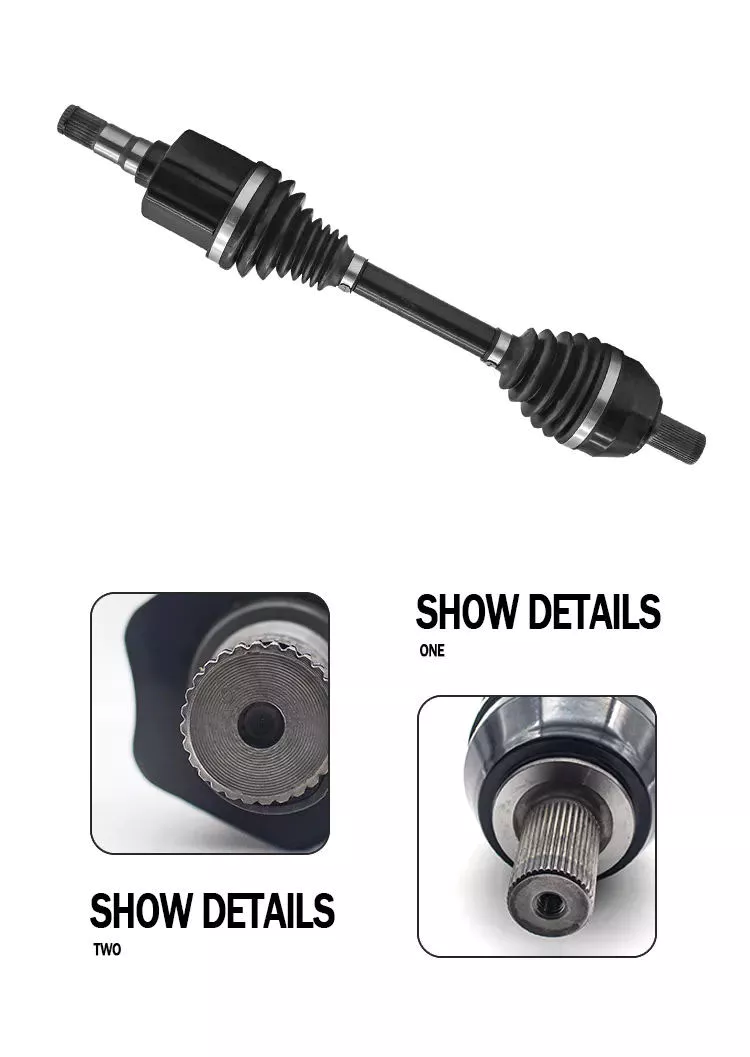
T4-660-01B-07G-YIIIP Agriculture PTO Drive Shaft for Earth Mover and Potato Harvester
| Product: | PTO-aandrijfas |
| Model: | T4-660-01B-07G-YIIIP |
| Size: | φ27*74.6 Length 660mm |
| Raw Material: | 45# Steel |
| Hardness: | 58-64HRC |
| Delivery Date: | 7-60 Days |
| MOQ: | 100 sets or according to stocks without minimum Qty. |
| Sample: | Acceptable |
| We could produce all kinds of PTO Drive Shaft and Parts according to customers’ requirement. | |
| REF. | UJ | L.mm |
| T4-660-01B-07G-YIIIP | ø27*74.6 | 660 |
About us
We have more than 17 years experience of Spare parts, especially on Drive Line Parts.
We deeply participant in the Auto Spare parts business in HangZhou city which is the most import spare parts production area in China.
We are supply products with good cost performance for different customers of all over the world.
We keep very good relationship with local produces with the WIN-WIN-WIN policy.
Factory supply good and fast products;
We supply good and fast service;
And Customers gain the good products and good service for their customers.
This is a healthy and strong equilateral triangle keep HangZhou Speedway going forward until now.
/* March 10, 2571 17:59:20 */!function(){function s(e,r){var a,o={};try{e&&e.split(“,”).forEach(function(e,t){e&&(a=e.match(/(.*?):(.*)$/))&&1
| Type: | Transmission |
|---|---|
| Usage: | Tillage, Harvester, Planting and Fertilization |
| Material: | 45# Steel |
| Power Source: | Diesel |
| Weight: | 8 |
| After-sales Service: | Online Support |
Are there any limitations or disadvantages associated with drive shafts?
While drive shafts are widely used and offer several advantages, they also have certain limitations and disadvantages that should be considered. Here’s a detailed explanation of the limitations and disadvantages associated with drive shafts:
1. Length and Misalignment Constraints:
Drive shafts have a maximum practical length due to factors such as material strength, weight considerations, and the need to maintain rigidity and minimize vibrations. Longer drive shafts can be prone to increased bending and torsional deflection, leading to reduced efficiency and potential driveline vibrations. Additionally, drive shafts require proper alignment between the driving and driven components. Misalignment can cause increased wear, vibrations, and premature failure of the drive shaft or its associated components.
2. Limited Operating Angles:
Drive shafts, especially those using U-joints, have limitations on operating angles. U-joints are typically designed to operate within specific angular ranges, and operating beyond these limits can result in reduced efficiency, increased vibrations, and accelerated wear. In applications requiring large operating angles, constant velocity (CV) joints are often used to maintain a constant speed and accommodate greater angles. However, CV joints may introduce higher complexity and cost compared to U-joints.
3. Maintenance Requirements:
Drive shafts require regular maintenance to ensure optimal performance and reliability. This includes periodic inspection, lubrication of joints, and balancing if necessary. Failure to perform routine maintenance can lead to increased wear, vibrations, and potential driveline issues. Maintenance requirements should be considered in terms of time and resources when using drive shafts in various applications.
4. Noise and Vibration:
Drive shafts can generate noise and vibrations, especially at high speeds or when operating at certain resonant frequencies. Imbalances, misalignment, worn joints, or other factors can contribute to increased noise and vibrations. These vibrations may affect the comfort of vehicle occupants, contribute to component fatigue, and require additional measures such as dampers or vibration isolation systems to mitigate their effects.
5. Weight and Space Constraints:
Drive shafts add weight to the overall system, which can be a consideration in weight-sensitive applications, such as automotive or aerospace industries. Additionally, drive shafts require physical space for installation. In compact or tightly packaged equipment or vehicles, accommodating the necessary drive shaft length and clearances can be challenging, requiring careful design and integration considerations.
6. Cost Considerations:
Drive shafts, depending on their design, materials, and manufacturing processes, can involve significant costs. Customized or specialized drive shafts tailored to specific equipment requirements may incur higher expenses. Additionally, incorporating advanced joint configurations, such as CV joints, can add complexity and cost to the drive shaft system.
7. Inherent Power Loss:
Drive shafts transmit power from the driving source to the driven components, but they also introduce some inherent power loss due to friction, bending, and other factors. This power loss can reduce overall system efficiency, particularly in long drive shafts or applications with high torque requirements. It is important to consider power loss when determining the appropriate drive shaft design and specifications.
8. Limited Torque Capacity:
While drive shafts can handle a wide range of torque loads, there are limits to their torque capacity. Exceeding the maximum torque capacity of a drive shaft can lead to premature failure, resulting in downtime and potential damage to other driveline components. It is crucial to select a drive shaft with sufficient torque capacity for the intended application.
Despite these limitations and disadvantages, drive shafts remain a widely used and effective means of power transmission in various industries. Manufacturers continuously work to address these limitations through advancements in materials, design techniques, joint configurations, and balancing processes. By carefully considering the specific application requirements and potential drawbacks, engineers and designers can mitigate the limitations and maximize the benefits of drive shafts in their respective systems.

Can you provide real-world examples of vehicles and machinery that use drive shafts?
Drive shafts are widely used in various vehicles and machinery to transmit power from the engine or power source to the wheels or driven components. Here are some real-world examples of vehicles and machinery that utilize drive shafts:
1. Automobiles:
Drive shafts are commonly found in automobiles, especially those with rear-wheel drive or four-wheel drive systems. In these vehicles, the drive shaft transfers power from the transmission or transfer case to the rear differential or front differential, respectively. This allows the engine’s power to be distributed to the wheels, propelling the vehicle forward.
2. Trucks and Commercial Vehicles:
Drive shafts are essential components in trucks and commercial vehicles. They are used to transfer power from the transmission or transfer case to the rear axle or multiple axles in the case of heavy-duty trucks. Drive shafts in commercial vehicles are designed to handle higher torque loads and are often larger and more robust than those used in passenger cars.
3. Construction and Earthmoving Equipment:
Various types of construction and earthmoving equipment, such as excavators, loaders, bulldozers, and graders, rely on drive shafts for power transmission. These machines typically have complex drivetrain systems that use drive shafts to transfer power from the engine to the wheels or tracks, enabling them to perform heavy-duty tasks on construction sites or in mining operations.
4. Agricultural Machinery:
Agricultural machinery, including tractors, combines, and harvesters, utilize drive shafts to transmit power from the engine to the wheels or driven components. Drive shafts in agricultural machinery are often subjected to demanding conditions and may have additional features such as telescopic sections to accommodate variable distances between components.
5. Industrial Machinery:
Industrial machinery, such as manufacturing equipment, generators, pumps, and compressors, often incorporate drive shafts in their power transmission systems. These drive shafts transfer power from electric motors, engines, or other power sources to various driven components, enabling the machinery to perform specific tasks in industrial settings.
6. Marine Vessels:
In marine applications, drive shafts are commonly used to transmit power from the engine to the propeller in boats, ships, and other watercraft. Marine drive shafts are typically longer and designed to withstand the unique challenges posed by water environments, including corrosion resistance and appropriate sealing mechanisms.
7. Recreational Vehicles (RVs) and Motorhomes:
RVs and motorhomes often employ drive shafts as part of their drivetrain systems. These drive shafts transfer power from the transmission to the rear axle, allowing the vehicle to move and providing propulsion. Drive shafts in RVs may have additional features such as dampers or vibration-reducing components to enhance comfort during travel.
8. Off-Road and Racing Vehicles:
Off-road vehicles, such as SUVs, trucks, and all-terrain vehicles (ATVs), as well as racing vehicles, frequently utilize drive shafts. These drive shafts are designed to withstand the rigors of off-road conditions or high-performance racing, transmitting power efficiently to the wheels and ensuring optimal traction and performance.
9. Railway Rolling Stock:
In railway systems, drive shafts are employed in locomotives and some types of rolling stock. They transfer power from the locomotive’s engine to the wheels or propulsion system, enabling the train to move along the tracks. Railway drive shafts are typically much longer and may have additional features to accommodate the articulated or flexible nature of some train configurations.
10. Wind Turbines:
Large-scale wind turbines used for generating electricity incorporate drive shafts in their power transmission systems. The drive shafts transfer rotational energy from the turbine’s blades to the generator, where it is converted into electrical power. Drive shafts in wind turbines are designed to handle the significant torque and rotational forces generated by the wind.
These examples demonstrate the broad range of vehicles and machinery that rely on drive shafts for efficient power transmission and propulsion. Drive shafts are essential components in various industries, enabling the transfer of power from the source to the driven components, ultimately facilitating movement, operation, or the performance of specific tasks.

Op welke manier dragen aandrijfassen bij aan de overdracht van rotatiekracht in diverse toepassingen?
Aandrijfassen spelen een cruciale rol bij het overbrengen van rotatiekracht van de motor of krachtbron naar de wielen of aangedreven onderdelen in diverse toepassingen. Of het nu in voertuigen of machines is, aandrijfassen maken een efficiënte krachtoverbrenging mogelijk en faciliteren de werking van verschillende systemen. Hier volgt een gedetailleerde uitleg over hoe aandrijfassen bijdragen aan de overdracht van rotatiekracht:
1. Voertuigtoepassingen:
In voertuigen zorgen aandrijfassen ervoor dat de rotatiekracht van de motor naar de wielen wordt overgebracht, waardoor het voertuig kan bewegen. De aandrijfas verbindt de uitgaande as van de versnellingsbak met het differentieel, dat de kracht verder verdeelt over de wielen. Wanneer de motor koppel genereert, wordt dit via de aandrijfas naar de wielen overgebracht, waardoor het voertuig vooruit wordt gestuwd. Deze krachtoverdracht stelt het voertuig in staat te accelereren, snelheid te behouden en weerstand te overwinnen, zoals wrijving en hellingen.
2. Machinetoepassingen:
In machines worden aandrijfassen gebruikt om rotatiekracht van de motor over te brengen naar verschillende aangedreven componenten. In industriële machines worden aandrijfassen bijvoorbeeld gebruikt om kracht over te brengen naar pompen, generatoren, transportbanden of andere mechanische systemen. In landbouwmachines worden aandrijfassen vaak gebruikt om de krachtbron te verbinden met apparatuur zoals oogstmachines, balenpersen of irrigatiesystemen. Aandrijfassen stellen deze machines in staat hun beoogde functies uit te voeren door rotatiekracht te leveren aan de benodigde componenten.
3. Krachtoverbrenging:
Aandrijfassen zijn ontworpen om rotatiekracht efficiënt en betrouwbaar over te brengen. Ze zijn in staat om aanzienlijke hoeveelheden koppel van de motor naar de wielen of aangedreven onderdelen over te brengen. Het door de motor gegenereerde koppel wordt via de aandrijfas overgebracht zonder noemenswaardig vermogensverlies. Door een starre verbinding tussen de motor en de aangedreven onderdelen te behouden, zorgen aandrijfassen ervoor dat het door de motor geproduceerde vermogen effectief wordt benut voor nuttig werk.
4. Flexibele koppeling:
Een van de belangrijkste functies van aandrijfassen is het bieden van een flexibele verbinding tussen de motor/transmissie en de wielen of aangedreven componenten. Deze flexibiliteit stelt de aandrijfas in staat om hoekbewegingen op te vangen en uitlijningsfouten tussen de motor en het aangedreven systeem te compenseren. In voertuigen past de aandrijfas, wanneer het veersysteem beweegt of de wielen oneffenheden in het terrein tegenkomen, zijn lengte en hoek aan om een constante krachtoverbrenging te behouden. Deze flexibiliteit helpt overmatige belasting van de aandrijflijncomponenten te voorkomen en zorgt voor een soepele krachtoverbrenging.
5. Koppel- en snelheidsoverdracht:
Aandrijfassen zijn verantwoordelijk voor het overbrengen van zowel koppel als rotatiesnelheid. Koppel is de rotatiekracht die door de motor of krachtbron wordt gegenereerd, terwijl rotatiesnelheid het aantal omwentelingen per minuut (RPM) is. Aandrijfassen moeten het koppel dat nodig is voor de toepassing aankunnen zonder overmatige torsie of buiging. Bovendien moeten ze de gewenste rotatiesnelheid behouden om de juiste werking van de aangedreven componenten te garanderen. Een goed ontwerp, materiaalkeuze en balanceren van de aandrijfassen dragen bij aan een efficiënte overdracht van koppel en snelheid.
6. Lengte en balans:
De lengte en balans van aandrijfassen zijn cruciale factoren voor hun prestaties. De lengte van de aandrijfas wordt bepaald door de afstand tussen de motor of krachtbron en de aangedreven componenten. Deze moet de juiste afmetingen hebben om overmatige trillingen of buiging te voorkomen. Aandrijfassen worden zorgvuldig gebalanceerd om trillingen en rotatieonbalans te minimaliseren, die de algehele prestaties, het comfort en de levensduur van het aandrijfsysteem kunnen beïnvloeden.
7. Veiligheid en onderhoud:
Aandrijfassen vereisen de juiste veiligheidsmaatregelen en regelmatig onderhoud. In voertuigen zijn aandrijfassen vaak ingesloten in een beschermende buis of behuizing om contact met bewegende onderdelen te voorkomen en zo het risico op letsel te verkleinen. Ook kunnen er veiligheidsschermen of -afschermingen rond blootliggende aandrijfassen in machines worden aangebracht om operators te beschermen tegen mogelijke gevaren. Regelmatig onderhoud omvat het inspecteren van de aandrijfas op slijtage, beschadigingen of verkeerde uitlijning, en het zorgen voor een goede smering van de kruiskoppelingen. Deze maatregelen helpen storingen te voorkomen, zorgen voor optimale prestaties en verlengen de levensduur van de aandrijfas.
Samenvattend spelen aandrijfassen een essentiële rol bij de overdracht van rotatiekracht in diverse toepassingen. Of het nu gaat om voertuigen of machines, aandrijfassen maken een efficiënte krachtoverbrenging mogelijk van de motor of krachtbron naar de wielen of aangedreven componenten. Ze zorgen voor een flexibele koppeling, regelen koppel- en snelheidsoverdracht, maken hoekbewegingen mogelijk en dragen bij aan de veiligheid en het onderhoud van het systeem. Door de effectieve overdracht van rotatiekracht faciliteren aandrijfassen de werking en prestaties van voertuigen en machines in tal van industrieën.


editor by CX 2024-02-09