
Precision PTO Drive Shaft Architecture for Broadcast Seeders
Australian Topography Adaptation & Kinetic Distribution Engineering
Engineered by EVER-POWER. Ensuring absolute rotational stability and advanced corrosion resistance for broadacre seeding and fertilizer spreading operations.
Core Technology Rapid Read: Rotational Stability in Seeding
The kinematic linkage between a prime mover and a broadcast seeder dictates the uniform distribution of seeds or granular fertilizers. A minute fluctuation in the rotational velocity of the spreading discs directly translates to uneven crop emergence and compromised yield. The primary function of an advanced PTO drive shaft in this environment is to provide a seamless, vibration-free transfer of mechanical energy, isolating the implement from the tractor’s engine harmonics.
In our 15 years of diagnosing driveline failures across the Australian outback, we documented that standard aftermarket shafts frequently suffer from accelerated corrosive pitting when exposed to urea and damp granular fertilizers. Based on this 10-year factory case tracking, EVER-POWER completely reformulated the metallurgical surface treatments. We integrated Dacromet coating processes and triple-lip FKM seals, guaranteeing continuous power transfer at 540 RPM while completely sealing the needle bearings from caustic dust and silica ingress.
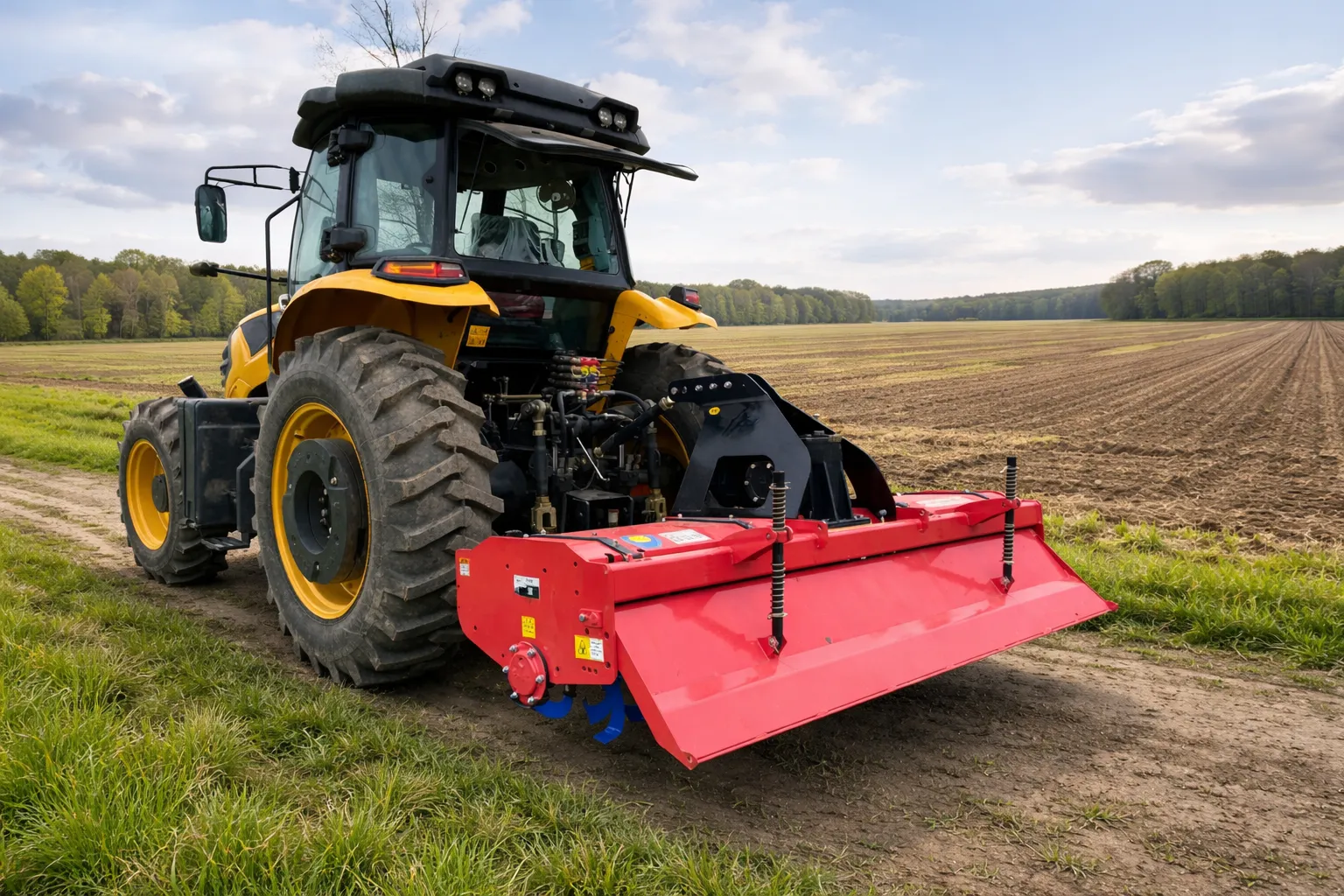
Principles of Broadcast Seeder Mechanisms
A broadcast seeder (or fertilizer spreader) typically relies on a central right-angle gearbox to convert the horizontal input from the tractor PTO into vertical rotation, driving the agitator and the base spinning discs. The operational dynamics present unique challenges:
Inertial Backlash Control
Large twin-disc spreaders generate massive rotational inertia. If the tractor engine decelerates rapidly, the kinetic energy of the spinning discs attempts to drive the tractor transmission forward. Our shafts integrate an Overrunning Clutch (Free-wheel mechanism) allowing the implement to decelerate independently, protecting the PTO output housing.
Torsional Deflection Tolerance
Fertilizer clumping can cause instantaneous locking of the hopper agitator. When the agitator jams, torque spikes exponentially. Our calibrated shear-bolt yokes provide a distinct mechanical fuse point, severing the power flow at precisely 1200 Nm (for Series 4), preventing catastrophic gearbox destruction.
Telescopic Compensation
As the tractor navigates uneven terrain, the geometric distance between the PTO stub and the implement input shaft changes constantly. Our involute splined or lemon-profile tubes are coated with proprietary anti-friction polymers, ensuring zero thrust-load binding under full torque.
Component Engineering Parameters
The following engineering matrix outlines the strict mechanical thresholds for our Series 2 to Series 6 drivelines optimized for broadacre seeding operations.
| Specification Criterion | Standard Blueprint Value | Custom Modification Range | Engineering Relevance for Seeders |
|---|---|---|---|
| Nominal Rotational Velocity | 540 RPM | 1000 RPM (High-capacity pneumatic) | Matches standard utility tractor output frequencies. |
| Dynamic Torque Rating (Series 4) | 460 Nm continuous | Up to 1250 Nm (Series 6) | Prevents mechanical yielding during hopper clump blockages. |
| Cross Journal Geometry | 27 mm x 74.6 mm | 22 x 54 mm to 30.2 x 92 mm | Dictates joint load-bearing capacity and maintenance life. |
| Tractor Yoke Attachment | 1-3/8″ 6-Spline Quick Disconnect | 21-Spline / 1-3/4″ 20-Spline | Secure interfacing with standard prime movers. |
| Implement Yoke Coupling | Plain Bore (25mm) with Keyway | Splined / Overrunning Clutch Hub | Rigid connection to the fertilizer gearbox input. |
| Telescopic Profile Machining | Lemon Tube (Seamless) | Triangular / Asymmetric Star | Provides optimum slide characteristic under load. |
| Static Closed Length | 800 mm (31.5 inches) | 500 mm to 2500 mm | Accommodates 3-point linkage spatial envelopes. |
| Metallurgical Forging | 20CrMnTi Alloy Steel | 42CrMo for heavy-duty yokes | Eliminates brittle fracture common in cast components. |
| Surface Heat Treatment | Carburized to HRC 58-62 | Induction hardened splines | Ensures absolute wear resistance at contact points. |
| Corrosion Inhibition | Dacromet Coating | Hot-Dip Galvanized / Epoxied | Critical defense against ammonium nitrate rust. |
| Safety Shield Polymer | UV-Stabilized Polyethylene | High-Impact PVC / Wide-Cone | Resists embrittlement under extreme sunlight. |
| Restraining Mechanism | Twin Steel Anti-Rotation Chains | Nylon coated cable restraints | Anchors guard to prevent hazardous high-speed rotation. |
| Kinematic Balance Grade | Class G16 | G6.3 Precision Balancing | Eliminates sympathetic vibrations passing to the hopper. |
| Operating Deflection Angle | 25 Degrees Continuous | 80 Degrees (Wide-Angle CV) | Determines the turning radius without disengaging PTO. |
| Bearing Seal Architecture | Triple-Lip NBR | FKM (Viton) for severe heat | Blocks microscopic silica and fertilizer dust penetration. |
| Overload Protection | Shear Bolt Yoke (M8 Grade 8.8) | Friction Disc / Ratchet Clutch | Calculated breaking point to save the main drivetrain. |
| Tribological Lubrication Interval | 50 Operating Hours | 250 Hour Long-Life Cross Kits | Decreases downtime during narrow planting windows. |
| Ambient Temperature Range | -20°C to +80°C | -40°C Arctic Spec | Maintains polymer integrity in extreme conditions. |
| Tube Wall Thickness | 3.2 mm (Inner) / 3.4 mm (Outer) | 4.0 mm Heavy Duty | Resists bending moment caused by offset pulling angles. |
| Global Compliance Testing | ISO 5673-1 | CE / AS 1121.2-2007 | Legal compliance for Australian machinery regulations. |
Driveline Discrepancy: High-Performance vs. Budget Assemblies
The discrepancy between an engineering-grade driveline and a low-cost substitute reveals itself violently in the field. Below is the technical delta demonstrating why EVER-POWER shafts outlast competitors.
Metallurgical Yield Strength
Commodity shafts frequently utilize brittle cast iron yokes to cut costs. Under sudden torsion (e.g., a jammed spreader disc), these explode. We use exclusively micro-alloyed forged steel, offering triple the tensile strength, safely absorbing shock waves without structural tearing.
Tribological Tolerance & Friction
Telescoping tubes under torque generate immense internal friction. Budget shafts bind, transferring thousands of pounds of thrust load into the tractor’s PTO housing. Our profile tubes undergo precision CNC broaching and are treated with friction-reducing graphite compounds.
Chemical Defense Geometry
Nitrogen-based fertilizers actively corrode exposed carbon steel. Standard paint flakes off in weeks. Our yokes and tubes feature a baked epoxy and Dacromet finish that passes the 1000-hour salt spray test, ensuring the locking collars and slip mechanisms never rust shut.

Cross-Platform Integration & Dimensional Equivalency
Agricultural machinery maintenance requires rapid component interchangeability. Our yoke geometries, universal joint dimensions, and profile tube designs offer exact dimensional equivalents to major global architectures, enabling drop-in replacement without altering the seeder’s input shaft.
| Original Target Architecture | Primary Tube Profile | Typical Spreader Brand | EVER-POWER Equivalent Series |
|---|---|---|---|
| Italian Specification (Comer / B&P) | Triangular / Lemon | Kuhn, Amazone (Select Models) | T-Series / L-Series |
| German Specification (Walterscheid) | Star Profile / Lemon | Bogballe, Sulky | W-Series Profiles |
| North American (Weasler) | Rectangular / Splined | John Deere OEM attachments | AW-Series |
| Australian Market (Bare-Co) | Various Standards | Silvan, Croplands | Direct Sub-assembly replacement |
Victoria & NSW Local Industry Safety Frameworks
Operating agricultural equipment across Australia dictates absolute adherence to state-level occupational health codes. The PTO driveline represents a critical compliance node due to its high-speed rotational hazards.
AS 1121.2-2007 Certification Dictates
Regulatory bodies such as WorkSafe Victoria and SafeWork NSW impose strict penalties for unguarded or improperly shielded drive shafts. EVER-POWER implements a zero-exposure philosophy. Our complete driveline assemblies are fully compliant with Australian Standard AS 1121.2-2007, utilizing master shield interfaces and robust U-joint cowlings.
Furthermore, UV radiation in regions like Queensland rapidly degrades standard European plastics. Our guard polymer matrix is heavily infused with UV stabilizers, tested to resist embrittlement for years under the harsh Australian sun, preventing the fatal shattering that exposes rotating steel components. Upgrading to our certified shafts ensures your fleet passes all state safety audits and qualifies for agricultural safety improvement grants.
Power Driveline Selection Protocol
Mismatched torque ratings are the leading cause of implement gearbox failure. Follow this exact engineering logic path to specify the correct shaft for your seeder.
Calculate Dynamic Overlap (Length)
Measure cross-center to cross-center when the tractor and seeder are perfectly level (shortest distance). The shaft must have at least 50mm of compression clearance to avoid bottoming out, whilst retaining a minimum of 1/3 tube overlap at maximum extension.
Identify Terminal Couplings
Verify the tractor’s PTO stub (standard is 1-3/8″ 6-spline). Inspect the seeder’s input shaft: is it a smooth cylinder requiring a cross-bolt (e.g., 25mm bore), or does it feature a splined shaft requiring a clamp yoke?
Assess Inertial Load & Safety Device
For single-disc lightweight seeders, a standard Series 1 or 2 shaft suffices. For large, twin-disc 3-ton fertilizer spreaders, specify a Series 4 shaft outfitted with an Overrunning Clutch to negate heavy rotational inertia upon deceleration.
Implementation & Commissioning Procedure
Improper installation initiates micro-fractures in the U-joint bearings. Execute these steps:
- Spline Purification: Wire-brush the tractor stub and implement shaft. Apply high-pressure molybdenum grease.
- Locking Mechanism Engagement: Depress the quick-release pin, push the yoke forward, and pull back sharply to ensure the steel locking ball seats fully into the spline groove.
- Phase Alignment Verification: If the shaft was separated for shortening, ensure the inner and outer yokes are strictly parallel (in phase). Operating out of phase creates violent torsional oscillation.
- Guard Anchoring: Secure the anti-rotation chains to non-moving components on the tractor and seeder. Allow slight slack for turning, but ensure the plastic shield cannot rotate with the internal steel tubes.
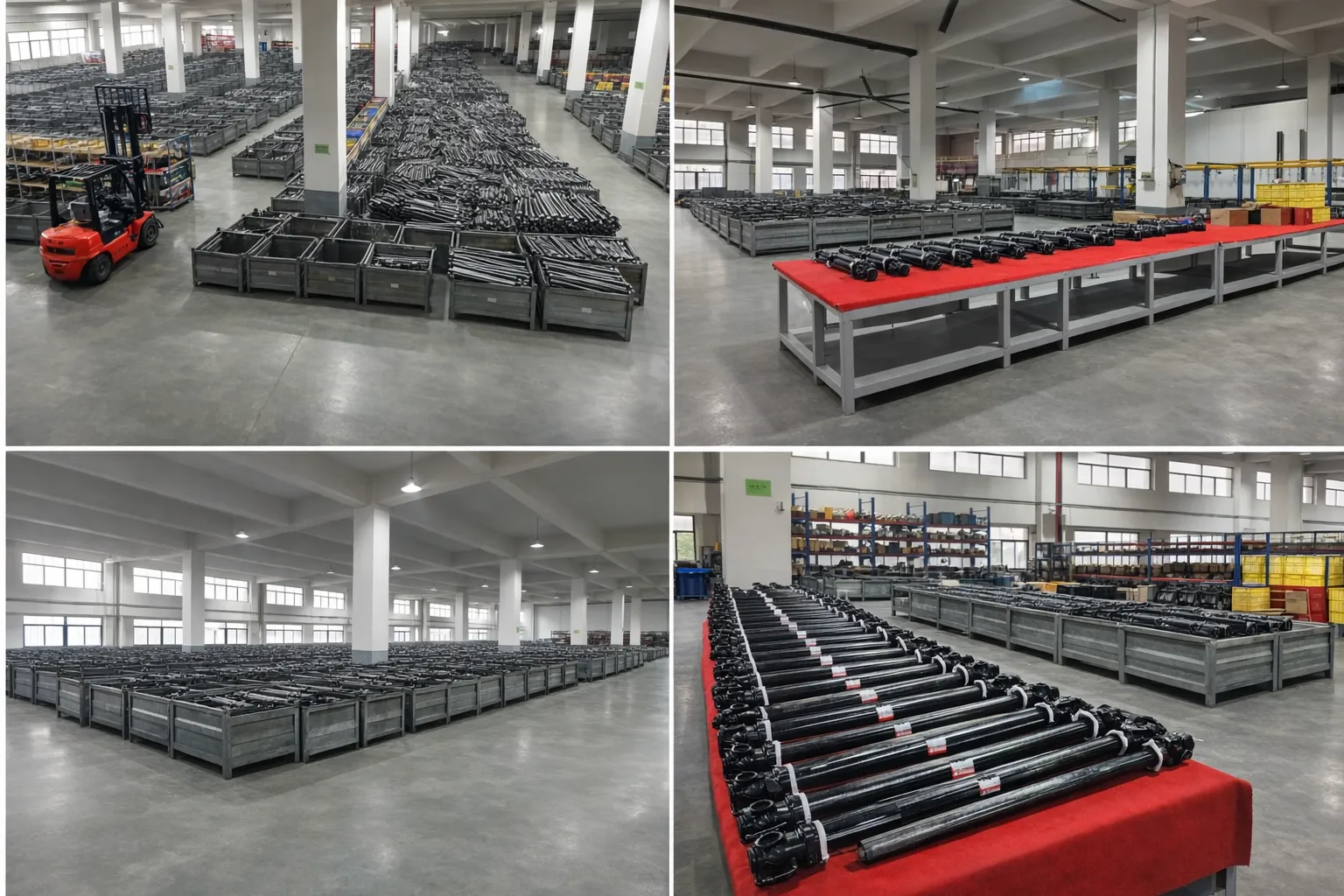
Diagnostic Matrix: Operational Fault Resolution
1. Violent Driveline Chatter or Knocking
Pathology: Yokes are out of phase; operating angle exceeds 25 degrees; needle bearings collapsed due to lack of grease.
Intervention: Separate tubes and align the phase markings. Level the three-point linkage to minimize joint angle. Inspect cross kits for play and replace immediately if loose.
2. Tractor Jerks Forward When PTO is Disengaged
Pathology: High inertia from twin spreading discs feeding back into the driveline. Lack of an overrunning clutch.
Intervention: Retrofit the implement side yoke with a dedicated Overrunning Clutch (RA type) to allow freewheeling deceleration.
3. Profile Tubes Seized / Cannot Expand
Pathology: Extreme torque twisted the outer tube, or chemical fertilizer dust fused the inner/outer profiles due to poor sealing.
Intervention: Attempt to separate with a winch. Clean aggressively with solvent and apply PTFE dry lube. If twisted, replace entire tube assembly as it will instantly destroy gearbox bearings.
Engineer’s Field Notes: Australian Terrain Implementation
Laboratory data is secondary to field survival. Below are unedited extracts from our engineering team’s diagnostic logs across diverse Australian agricultural zones.
Case 1: Wagga Wagga, NSW – Broadacre Sowing
Scenario: 40-foot air seeder cart utilizing an auxiliary PTO blower fan. The customer reported continuous tractor transmission seal failures.
Intervention: Investigated and found massive inertial feedback when disengaging the 1000 RPM blower. Installed an EVER-POWER Series 6 shaft with a specialized high-capacity overrunning clutch.
Result: “The freewheel mechanism completely isolated the tractor. Zero seal leaks in the last 18 months of intensive sowing.”
Case 2: Toowoomba, QLD – Humid Fertilizer Spread
Scenario: Spreading urea in high humidity. Competitor shafts were seizing solid within 8 weeks due to extreme rust binding the telescopic tubes.
Intervention: Deployed shafts utilizing our Dacromet coating process combined with Rilsan-coated inner splines to reject moisture and chemical bonding.
Result: “First time we’ve had a shaft slide smoothly all season without needing a sledgehammer to separate the tractor from the spreader.”
Case 3: Ballarat, VIC – Undulating Pasture Improvement
Scenario: Trailed seeder navigating steep gullies. U-joints were snapping due to extreme angles at the drawbar pivot point.
Intervention: Upgraded the tractor side to an 80-Degree Constant Velocity (CV) Wide-Angle joint, allowing continuous power flow through tight contour turns.
Result: “Turning time cut by 25%. No more disengaging the PTO at headlands or creeping through creek beds.”
Case 4: Mount Gambier, SA – Coastal Exposure
Scenario: Salt-laden coastal air combined with high UV index was turning standard safety guards into brittle shrapnel.
Intervention: Supplied our custom UV-stabilized, high-density polyethylene shielding system with deep-skirt cones.
Result: “The guards have survived two full seasons sitting out in the sun and salt without a single crack. Passed the local WorkSafe audit easily.”
Case 5: Northam, WA – Heavy Pan Breaking & Seeding
Scenario: High-vibration dry seeding. Cross bearings were running dry and disintegrating prematurely in the dust.
Intervention: Fitted custom cross kits featuring centralized grease reservoirs and triple-lip FKM seals to block microscopic dust ingress.
Result: “Maintenance intervals pushed from daily greasing to weekly. The bearings run cool to the touch even after 12 hours of continuous sowing.”
Frequently Asked Engineering & Application Questions
1. What shaft series is required for a twin-disc fertilizer spreader?
Typically, a Series 4 shaft is ideal. Twin discs generate significant torque and inertia. Series 4 handles up to 460 Nm continuously, providing ample safety margin against hopper jams.
2. How do I prevent fertilizer dust from destroying the sliding tubes?
Do not use wet, sticky grease on the profile tubes, as it creates a grinding paste with the dust. Separate the tubes, clean with solvent, and apply a dry PTFE or graphite-based spray lubricant.
3. Can I replace a broken plastic guard, or do I need a whole new shaft?
Yes, replacement guard kits (cones, tubes, and bearings) are available and easy to retrofit. Never operate the seeder without an intact guard; it is illegal and highly dangerous.
4. What is the difference between a Lemon and a Star profile tube?
Lemon profiles (common in German engineering) offer thick wall sections at high stress points for durability. Star profiles provide more surface contact area, giving slightly better resistance to torsional twisting under extreme loads.
5. Why does my shear bolt keep breaking instantly?
Ensure you are engaging the PTO at engine idle before ramping up to 540 RPM. Also, verify you are using the correct metallurgical grade bolt (e.g., 8.8). Do not upgrade to a 10.9 bolt, as you will destroy the gearbox instead.
6. Is it safe to cut a PTO shaft to make it fit?
Yes. If bottoming out occurs, precisely measure and cut equal amounts from both the inner and outer steel profile tubes, as well as the plastic guard tubes. Deburr the edges aggressively before reassembly.
7. How often should the cross journals be greased during seeding season?
Standard protocol is 50 hours. However, in heavy dust or after pressure washing, purge greasing (pumping until clean grease exits the seals) should be performed every 25 hours.
8. What does an overrunning clutch actually do?
It acts like a bicycle freewheel. It transmits power in one direction (from tractor to implement) but allows the implement to spin freely faster than the tractor PTO, safely dissipating inertial kinetic energy.
9. How do I know if my yokes are ‘out of phase’?
Look at the U-joints on both ends. The internal bearing caps (on the inner tube) must align perfectly parallel with the external bearing caps (on the outer tube). Most tubes feature a physical alignment arrow stamped into the steel.
10. Can you manufacture custom shafts for imported European spreaders?
Yes. As an OEM manufacturer, EVER-POWER can custom-forge specific metric yokes, specific tube profiles, and calibrate slip clutches to exactly match the blueprints of any imported machinery.

Integrated Kinematic Systems: Gearboxes & Power Components
The driveline is only one half of the equation. We engineer the complete power transmission chain from the tractor to the spreading discs.
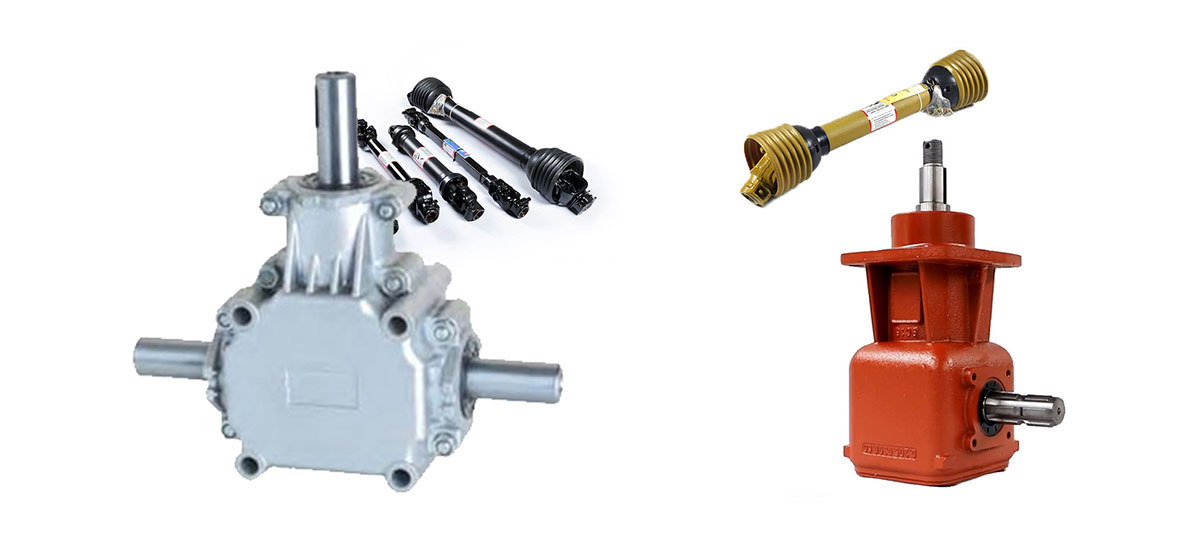
Broadcast Seeder Gearboxes
Designed to receive input from our PTO shafts, these agricultural gearboxes feature cast-iron housings and carburized spiral bevel gears. They efficiently redirect horizontal power 90 degrees downward to spin the dispersal discs with absolute precision.
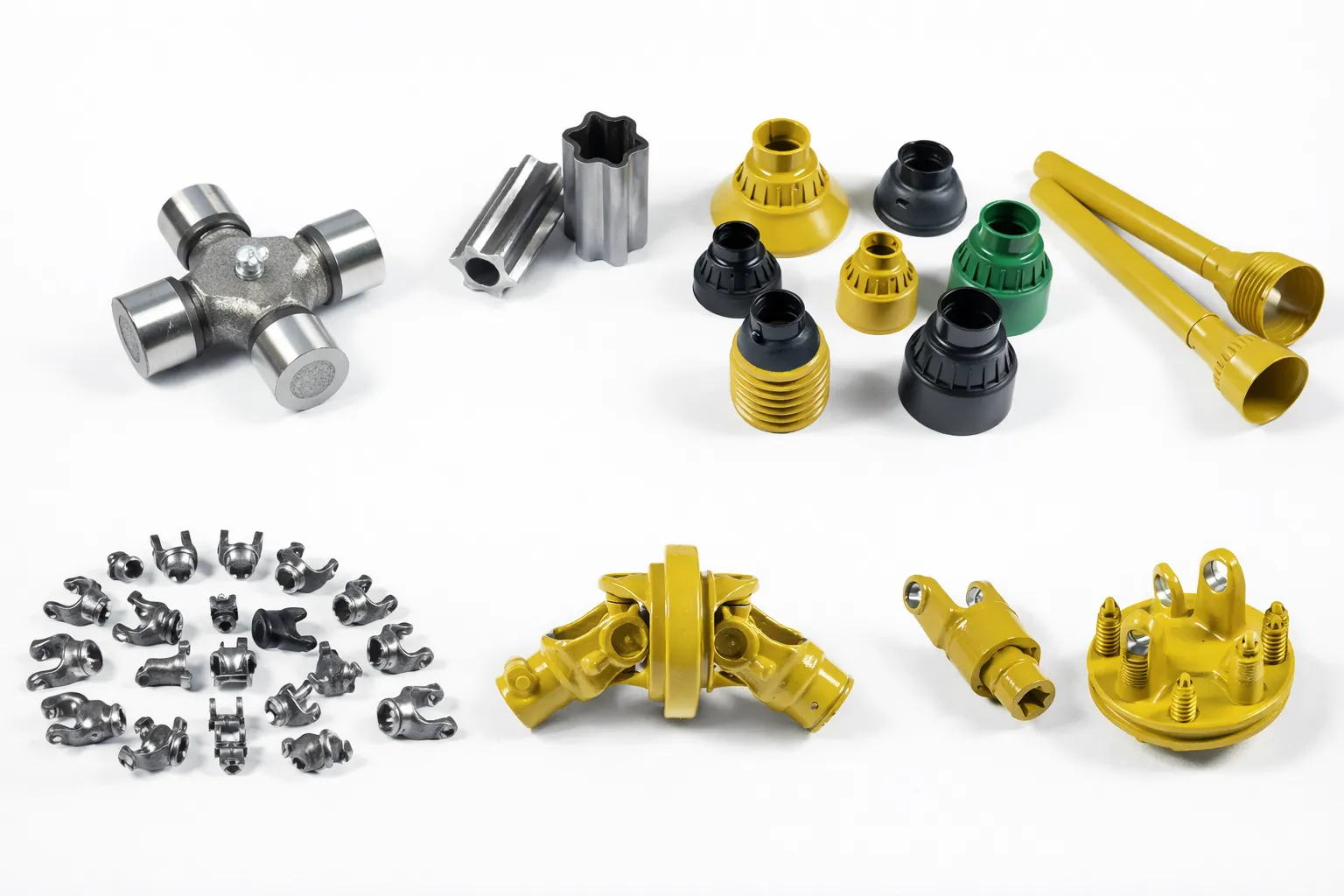
Yokes & Cross Bearing Kits
Minimize downtime with our exact-tolerance replacement parts. From 1-3/8″ splined quick-disconnect yokes to heavy-duty cross journals featuring centralized lubrication ports, we supply the components necessary to rebuild any driveline.

Sprockets, Chains & Pulleys
For seeders utilizing secondary drive mechanisms, we manufacture induction-hardened sprockets, high-tensile roller chains, and dynamically balanced V-belt pulleys, ensuring dimensional harmony across the entire implement.
Fortify Your Agricultural Fleet Today
EVER-POWER operates beyond the limitations of standard catalog suppliers. Leveraging a vertically integrated manufacturing matrix—from metallurgical forging to CNC broaching and dynamic balancing—we engineer power transmission solutions that eliminate downtime. Whether you require standard Series 4 assemblies or custom-length, chemically-resistant drivelines for specialized spreading equipment, our engineering team is ready to analyze your blueprints.
Our kinematic engineers provide comprehensive torque analysis and blueprint reviews within 24 hours.