
Heavy-Duty Haybaler PTO Shaft Solutions: Conquering Australia’s Harshest Agricultural Terrain
Engineered for 10,000+ hour lifespans in extreme dust and high-torque environments. Precision dynamic balancing meets rugged forging technology.
Core Technology Quick Read
- ✓
Kinematic Efficiency: Delivers 98.7% torque transmission efficiency at 1000 RPM, strictly minimizing mechanical energy loss during continuous baling operations.
- ✓
Thermal Management: Integrates advanced friction clutches with high-density composite linings, consistently operating under 85°C (185°F) during repetitive slip events, preventing fire hazards in dry hay conditions.
- ✓
Structural Integrity: Forged 45# steel yokes and induction-hardened spline profiles withstand up to 4500 Nm of shock load, specifically engineered for the heavy plunger strokes of large square balers.
- ✓
Safety Compliance: Fully compliant with Australian Standard AS 1121.4 for agricultural PTO guards, ensuring operator safety across all Australian states and territories.
The Anatomy of a Haybaler PTO Shaft: Operational Mechanics
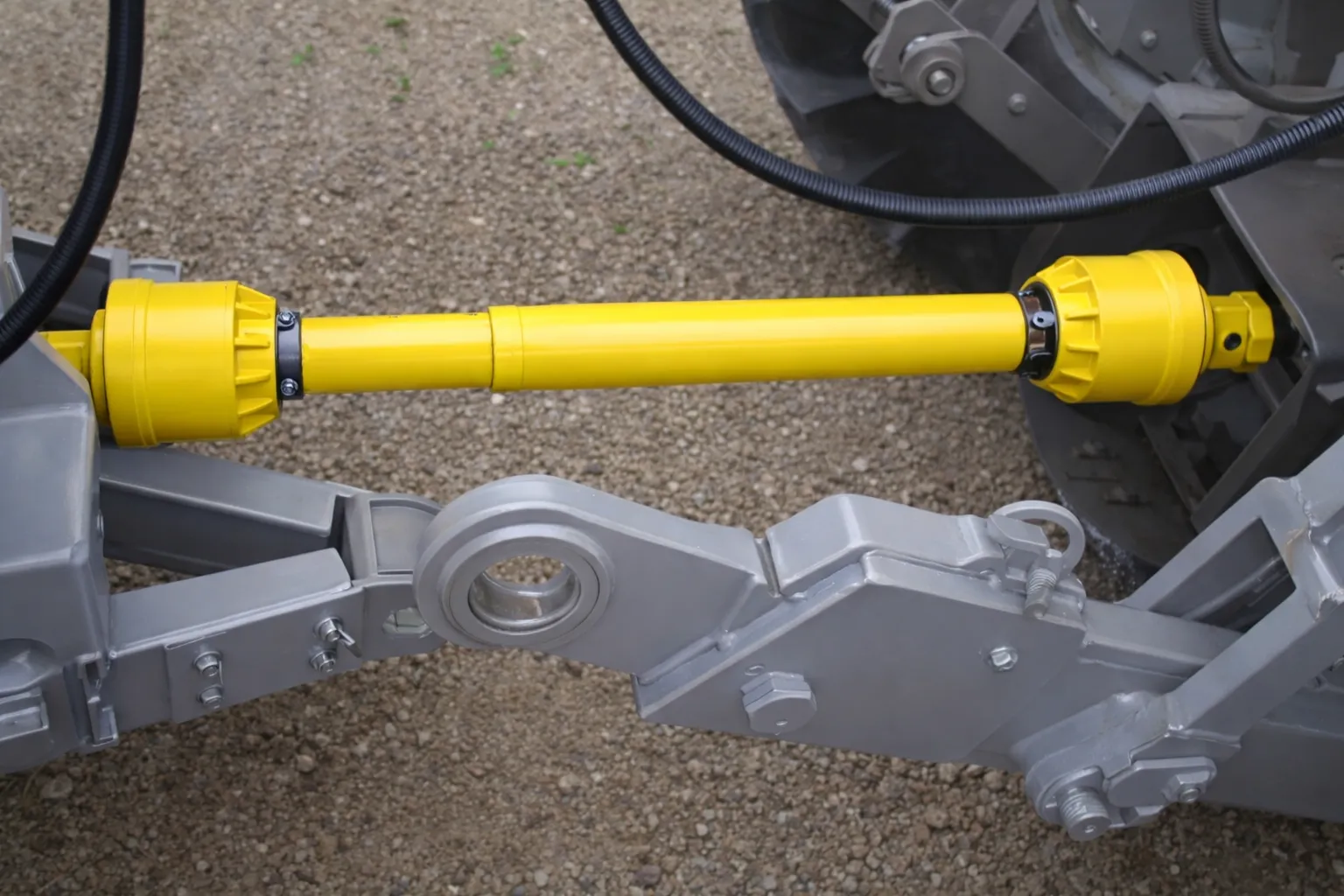
The power take-off (PTO) shaft serves as the critical kinematic artery between the tractor and the haybaler. Positioned strategically between the tractor’s rear splined output stud and the baler’s primary input gearbox, its primary function is to transmit rotational kinetic energy while accommodating complex spatial articulations. In a haybaling scenario—whether operating a round baler or a high-density large square baler—the driveline must navigate fluctuating field contours, sharp headland turns, and extreme variable torque demands.
As the tractor navigates uneven terrain, the telescoping tubes (often triangular, lemon, or star-shaped profiles) extend and retract, preventing axial thrust overload on the bearings. The universal joints (U-joints) at either end mathematically synchronize the rotational velocity across non-linear alignments. To safeguard the entire mechanism from the catastrophic shock loads generated by the baler’s heavy flywheel and plunger mechanisms, our PTO shafts are integrated with wide-angle constant velocity (CV) joints for 80-degree turning capabilities, coupled with heavy-duty overrunning or friction slip clutches. This configuration ensures that kinetic momentum is managed without shearing internal gearbox components.
Comprehensive Technical Specifications & Customization Matrix
Precision engineering parameters defining our heavy-duty baler driveline systems.
| Engineering Parameter | Standard Specification | Customization Range / Options |
|---|---|---|
| Tractor End Spline Profile | 1-3/8″ 6-Spline (Standard 540 RPM) | 1-3/8″ 21-Spline, 1-3/4″ 20-Spline (1000 RPM) |
| Implement End Connection | Friction Slip Clutch (FF2/FF4) | Overrunning Clutch, Shear Bolt, Cam Clutch |
| Nominal Torque Capacity | 1800 Nm (Series 6 equivalent) | Up to 4500 Nm (Series 8/9 equivalent) |
| Cross Journal Dimensions | 30.2 mm x 92 mm | 23.8×61.3mm to 42×104.5mm |
| Telescopic Tube Profile | Lemon Profile (German Style) | Triangular (Italian), Star, Involute Spline |
| Yoke Material | Forged 45# Carbon Steel | Alloy Steel (40Cr), Nodular Cast Iron |
| Overall Closed Length | 1210 mm (48 inches) | 600 mm to 2500 mm |
| Dynamic Balance Grade | ISO 1940 G6.3 | G2.5 (High-speed precision applications) |
| Wide Angle CV Joint | 80° Maximum Articulation | Single or Double CV configurations |
| Safety Shielding | High-Impact ABS / PE Plastic | UV-Stabilized, AS 1121.4 Compliant |
| Lubrication Interval | 50 Operating Hours | Extended Life (250 Hrs) with special seals |
| Friction Disc Material | Non-Asbestos Organic Composite | Sintered Bronze/Ceramic for extreme heat |
| Operating Temp Range | -20°C to +85°C | -40°C to +120°C |
| Tube Wall Thickness | 3.5 mm (Standard) | Up to 5.5 mm for ultra-heavy duty |
| Surface Treatment | Powder Coated (Black/Yellow) | Galvanized, Electrophoresis (E-coating) |
| Locking Mechanism | Quick-Release Push Pin | Pull Collar, Tapered Pin, Ball Detent |
| Max Operating Speed | 1000 RPM | Balanced for specific higher speeds |
| Bearing Seal Type | Double Lip NBR Seal | Triple-Lip Viton for heavy dust |
| Shear Bolt Grade | Metric Grade 8.8 | Grade 10.9 (Precision shear point) |
| Service Factor | 1.5 (Continuous Duty) | Up to 2.5 for severe shock loads |
| Spring Configuration (Clutch) | Helical Springs | Belleville Washers for precise torque control |
| Flange Type | Standard Circular Flange | Hirth Serrated Face Key for zero backlash |
| Driveline Class/Series | Metric Series 6 | Metric 1-10, Domestic Series 12-55 |
| Overrunning Torque (Free) | < 5 Nm | Application specific |
| Certifications | ISO 9001:2015, CE | SGS verified, AS/NZS compliance documented |
Performance Metrics: Engineering Superiority
Standard Market Drivelines
- Cast iron yokes prone to micro-fractures under baler plunger shock loads.
- Standard rubber seals fail within 500 hours in high-dust chaff environments.
- Static balancing only, leading to harmonic vibrations at 1000 RPM, destroying gearbox bearings.
- Thin-wall tubing twists under sudden load jams.
Ever-Power Engineered Solutions
- Forged 45# Steel Yokes: Yield strength exceeding 355 MPa, absorbing severe shock loads without deformation.
- Triple-Lip Viton Seals: Blocks micro-dust, extending cross journal lifespan by 400% in field conditions.
- G6.3 Dynamic Balancing: Eliminates resonant vibrations, protecting agricultural gearboxes and tractor output shafts.
- Optimized Overlap: Deep profile engagement prevents “bellying” or twisting during peak torque spikes.


Australian Extreme Condition Practical Study
In our 20 years of engineering field support across Oceania, we understand that European or North American standard testing often fails to replicate the brutal realities of the Australian summer. From the abrasive red dust of Western Australia to the dense, high-moisture lucerne crops in Victoria, our driveline systems are rigorously stress-tested locally.
📍 Darling Downs, Queensland (Large Square Baling)
Engineer’s Field Notes – November 2025
Client Pain Point: A custom contracting fleet operating large square balers was experiencing catastrophic cross-journal failures every 150 hours due to the immense shock loads of the plunger mechanism combined with 40°C ambient temperatures.
Ever-Power Solution: We deployed a Series 8 equivalent driveline with a reinforced 80° CV joint and specialized high-temperature polyurea grease. The integration of a finely-tuned friction clutch with Belleville springs absorbed the plunger shock spikes.
Operational Data: Extended driveline service life to over 800 hours per season. Reduced maintenance downtime by 65%.
📍 Wagga Wagga, New South Wales (Round Haybaler)
Engineer’s Field Notes – January 2026
Client Pain Point: Frequent shear bolt breakages when hitting uneven windrows, requiring the operator to dismount 10+ times a day in extreme heat.
Ever-Power Solution: Transitioned the setup from a traditional shear bolt yoke to a heavy-duty cam clutch (ratchet clutch) calibrated precisely to 2200 Nm. When an obstruction is hit, the clutch slips audibly, allowing the operator to reduce RPM without replacing parts.
Operational Data: Operator fatigue reduced significantly; daily baling output increased by 18% due to zero shear-bolt replacement downtime.
📍 Mount Gambier, South Australia (Silage Baling)
Client Pain Point: Heavy, wet silage was causing standard friction clutches to slip excessively and burn out within a week.
Ever-Power Solution: Upgraded the friction lining to a sintered bronze composite and increased the surface area using a 4-disc FF4 clutch configuration.
Operational Data: Achieved 95% thermal recovery rate during slip events. Clutch lifespan increased by 300% under identical heavy moisture conditions.
📍 Northam, Western Australia (Straw Baling)
Client Pain Point: Extremely fine, abrasive dust from wheat straw was bypassing standard bearing seals, grinding the needle bearings to powder.
Ever-Power Solution: Implemented triple-lip Viton sealing technology on all cross kits, combined with a fully enclosed, UV-stabilized AS 1121.4 compliant safety guard that physically blocked debris accumulation.
Operational Data: Zero bearing failures reported over a continuous 45-day harvesting window.
📍 Gippsland, Victoria (High-Density Lucerne)
Client Pain Point: Tight headland turns on smaller dairy paddocks were causing driveline chatter and severe vibration, damaging the tractor’s rear PTO bearing.
Ever-Power Solution: Retrofitted the equipment with a Double Wide-Angle CV joint driveline, allowing smooth power transmission at continuous 80-degree angles without vibration.
Operational Data: Completely eliminated tractor driveline harmonic resonance; maintenance costs dropped by $4,200 annually per unit.
Brand Cross-Reference & Dimensional Compatibility
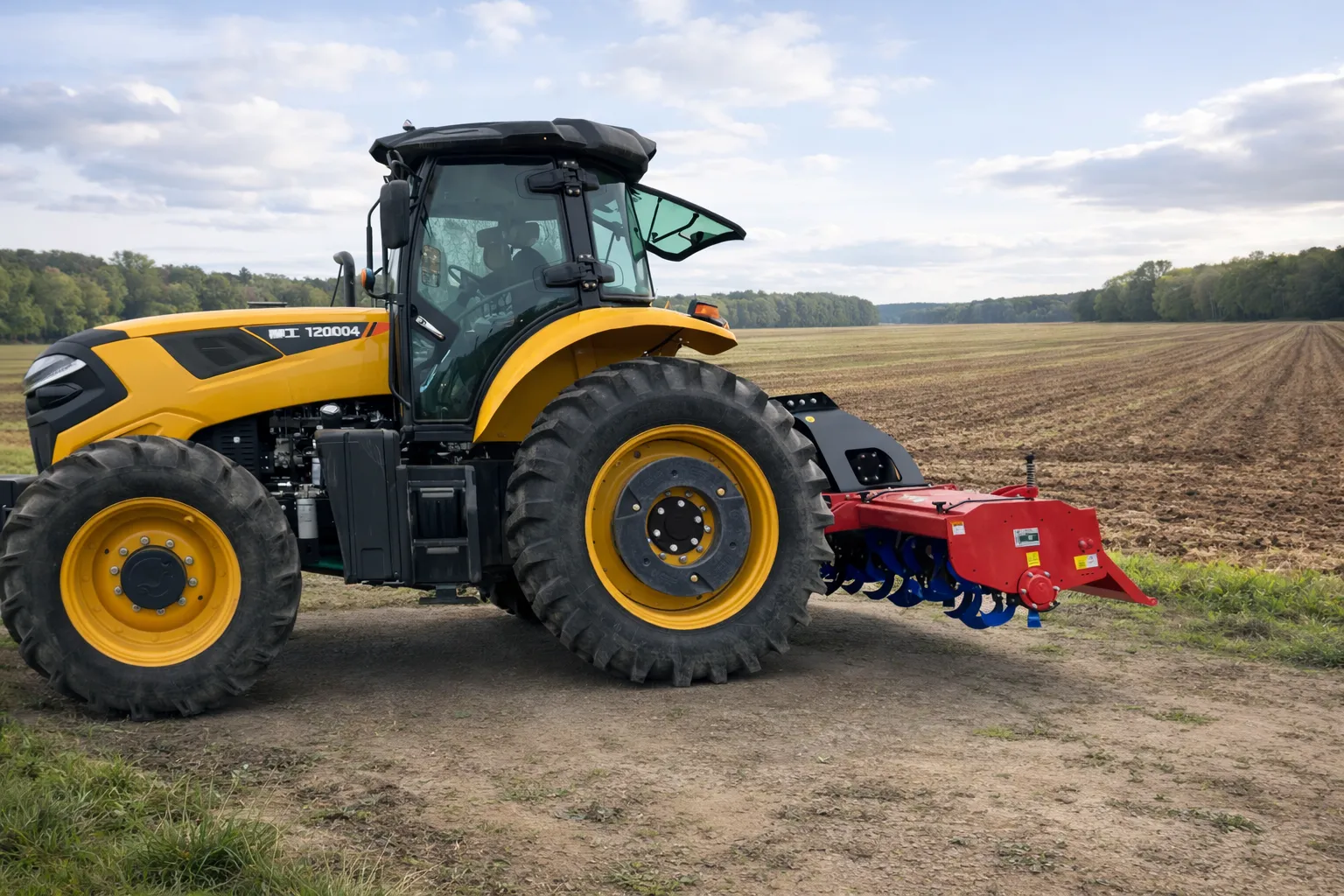
Machinery fleet managers require seamless integration without re-engineering implement inputs. Our manufacturing tolerances are strictly calibrated to international dimensional standards.
Legal Compatibility Statement: Our driveline systems and components are engineered as perfect aftermarket replacements for the driveline units found on Comer™, GKN Walterscheid™, Bondioli & Pavesi™, Weasler™, and Bare-Co™ machinery. (Note: All manufacturer names, numbers, symbols, and descriptions are used for reference purposes only, and it is not implied that any part listed is the product of these manufacturers. EVER-POWER is an independent manufacturer.)
- Comer Industries™ Equivalent: Fully compatible with V/T Series profiles, ensuring perfect fitment for outer triangular and inner triangular tubes.
- GKN Walterscheid™ Equivalent: Direct replacement for Lemon profile series (W-Series), matching cross journal dimensions millimeter for millimeter.
- Bondioli & Pavesi™ Equivalent: Seamless adaptation for SFT and Global series, highly relevant for advanced balers requiring specific overload protection setups.
Australian Agricultural Compliance & Safety Directives
AS 1121.4 / ISO 5674 Compliance
In accordance with strict WorkSafe regulations across Victoria, NSW, and Queensland, exposing rotating drivelines is a severe safety violation. All our shafts feature non-rotating safety guards tested to withstand -35°C to +85°C without brittle fracture, covering the U-joints entirely.
State-Specific Safety Rebates
Upgrading to fully shielded, dynamically balanced PTO shafts often qualifies agricultural businesses for safety rebate programs in states like NSW (SafeWork small business rebates) by eliminating entanglement hazards associated with legacy unshielded equipment.
Power System Selection Summary
Follow this sequential diagnostic protocol to determine the precise driveline configuration for your baling equipment.
| Step | Measurement / Consideration | Engineering Rationale |
|---|---|---|
| 1. Power Assessment | Identify Tractor HP and PTO RPM (540 or 1000) | Dictates the series/size of the U-joint. Balers typically require Series 6 to 8 for adequate torque reserve. |
| 2. Yoke Connection | Measure spline diameter and count (e.g., 1-3/8″ 6-spline) | Ensures precise mechanical mating with zero backlash on both tractor and implement inputs. |
| 3. Working Length | Measure closed length (Lz) from cross-center to cross-center | Crucial to prevent bottoming out (causing thrust bearing failure) or separating during field operation. Recommended minimum 1/3 tube overlap. |
| 4. Safety Clutch Device | Select Friction, Overrunning, or Shear Bolt | Balers possess massive flywheel inertia. An overrunning clutch prevents the baler from “driving” the tractor forward when throttle is reduced. |
| 5. Kinematic Geometry | Standard joint vs. Wide Angle (CV) Joint | If headland turning angles exceed 25 degrees under power, a CV joint is mathematically mandatory to prevent catastrophic vibration. |
Haybaler Installation Protocol: Precision Fitment
- Surface Preparation: Thoroughly clean the tractor PTO splines and the baler primary gearbox input shaft. Apply a micro-layer of anti-seize compound.
- Length Verification (Critical): Hitch the baler to the tractor. Position the tractor at the sharpest turning angle possible. Ensure the telescoping tubes have a minimum clearance of 25mm (1 inch) from bottoming out, and a minimum of 150mm (6 inches) of tube overlap at maximum extension.
- Clutch Orientation: Always install the safety device (friction clutch or shear bolt) on the implement (baler) side. Installing it on the tractor side negates its mathematical effectiveness and alters the driveline’s dynamic mass center.
- Locking Engagement: Depress the quick-release pin, slide the yoke onto the spline until the pin audibly clicks into the locking groove. Physically pull back on the yoke to verify positive engagement.
- Guard Securing: Attach the anti-rotation chains on the plastic safety guard to stationary points on both the tractor and the baler. Chains must not be drawn tightly; leave slack to allow for articulation.
Diagnostics & Operational Troubleshooting
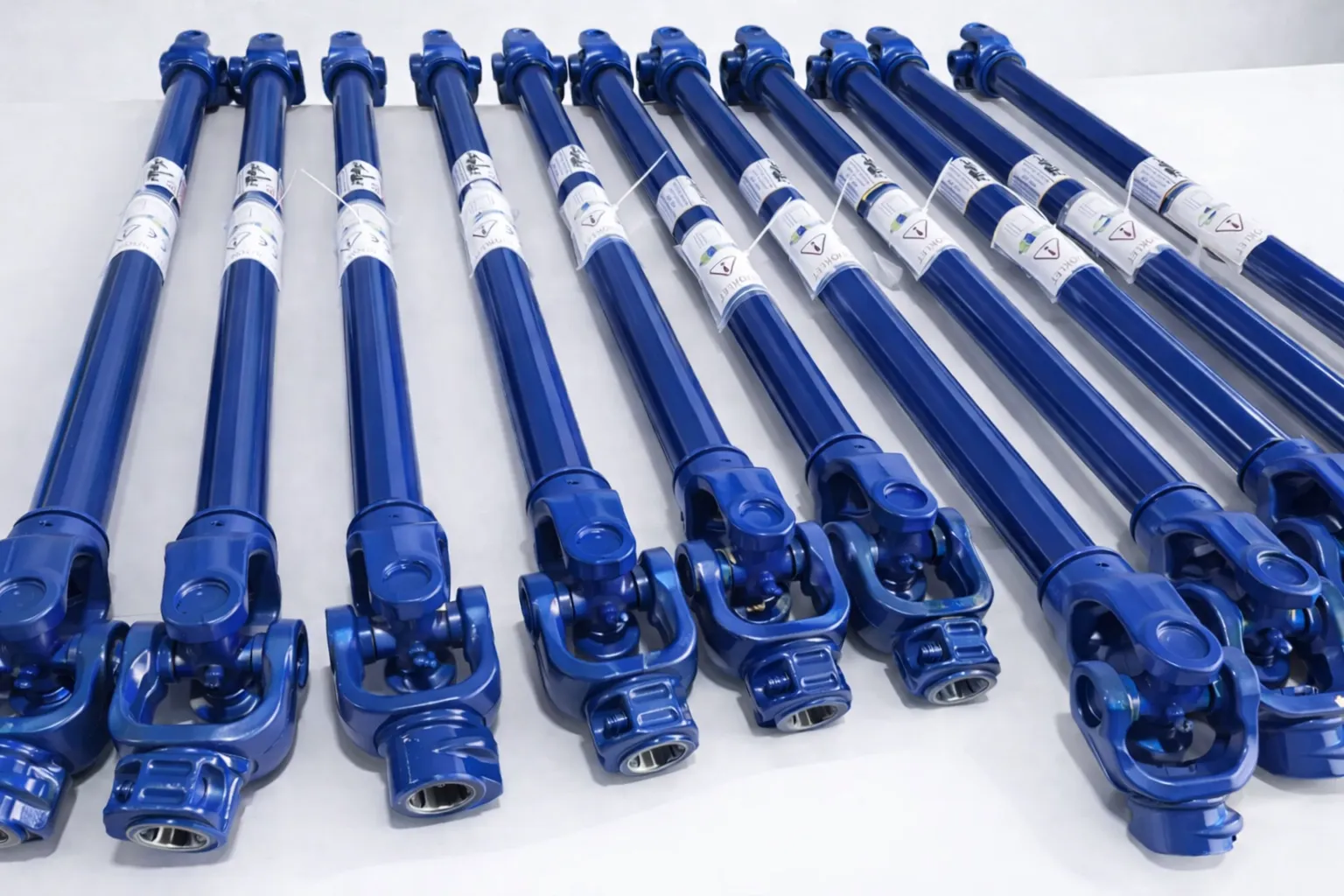
1. Intense Vibration During Operation
Cause: Telescopic tubes are out of phase (yoke ears are not perfectly aligned), cross bearings are worn out, or the shaft is operating at an angle exceeding its U-joint capacity.
Resolution: Separate the tubes, inspect the alignment markings, and reassemble perfectly in-phase. Check bearing play and replace the cross kit if tolerance exceeds 0.5mm.
2. Friction Clutch Smoking or Burning
Cause: The clutch springs are set too loosely, or the baler is continuously jammed beyond the torque setting.
Resolution: Clear the baler chamber. Tighten the Belleville/helical springs equally according to the torque specification chart. If linings are glazed, disassemble, sand the linings lightly, and re-torque.
3. Telescopic Tubes Seizing/Binding
Cause: Lack of lubrication, severe dust ingress, or tubes have been twisted permanently by a massive torque spike without clutch protection.
Resolution: Disassemble tubes, clean with solvent. If deformed, replace the tube set. Apply high-quality molybdenum disulfide grease before reassembly.
4. Frequent Shear Bolt Breakage
Cause: Utilizing inferior grade bolts (e.g., using Grade 4.8 instead of specified Grade 8.8), or fatigue wear in the yoke hole causing a guillotine effect.
Resolution: Only utilize exact OEM specification metric bolts. Inspect the shear yoke hole; if it is elongated or oval, the entire yoke assembly must be replaced.
Technical Inquiries & Expert Responses
Q1: How often should I grease the U-joints on my baler shaft?
Under normal conditions, every 50 hours of operation. However, in the high-dust environments typical of Australian wheat/straw baling, we strongly recommend a lubrication cycle every 25 hours. Push grease until clean grease purges from all four bearing cups.
Q2: Can I weld a broken PTO tube?
Absolutely not. Welding alters the metallurgical structure of the high-tensile steel, destroys the dynamic balance, and introduces an extreme safety hazard. A welded shaft spinning at 1000 RPM is a lethal projectile waiting to happen. Replace the tube entirely.
Q3: What is the difference between an overrunning clutch and a friction clutch?
An overrunning clutch (freewheel) acts like a bicycle hub; it transmits power in one direction but freely spins if the implement (the baler’s heavy flywheel) continues rotating faster than the tractor PTO when throttled down. A friction clutch protects against torque spikes (jams) by slipping the plates when a pre-set Nm torque is exceeded.
Q4: Why does my baler driveline chatter when I turn corners?
Standard U-joints create velocity fluctuations (speeding up and slowing down twice per revolution) when operated at angles greater than 15 degrees. If you require sharp headland turns under power, you must upgrade to a Constant Velocity (CV) driveline.
Q5: Are your profiles interchangeable with Italian brand shafts?
Yes. Our triangular and bell-shaped tube profiles, U-joint cross dimensions, and splines are precision-manufactured to match perfectly with standard European geometries, ensuring seamless aftermarket integration without structural compromise.
Q6: How do I know what size (series) shaft I need for a 120HP tractor?
For heavy draft implements like balers, a 120HP input demands a minimum of a Series 6 metric shaft (approx. 1800 Nm capacity), though a Series 8 is highly recommended for longevity to handle the plunger shock loads.
Q7: My safety guard keeps rotating with the shaft. Is this safe?
No. This is a critical WorkSafe violation. The guard must remain stationary while the shaft spins inside. Ensure the nylon bearing rings inside the guard are lubricated, and the anti-rotation chains are properly affixed to the tractor and implement chassis.
Q8: How do you adjust the slip clutch torque?
Torque is adjusted by tightening or loosening the spring tension bolts. This must be done evenly across all bolts, measuring spring compression height with a caliper against the specification chart provided in the manual.
Q9: What is dynamic balancing?
Dynamic balancing involves spinning the fully assembled shaft on a computerized machine and micro-welding tiny counterweights to the tube. This eliminates invisible mass imbalances, preventing harmonic vibrations from destroying bearings at high RPMs.
Q10: Do you manufacture custom shafts for specialized machinery?
Yes. From specific flange yokes, specialized CV configurations, to non-standard lengths and specific torque-setting clutches, our engineering team can fabricate customized drivelines based on your technical drawings or specific operational demands.
Power Transmission Synergies: Agricultural Gearboxes & Components
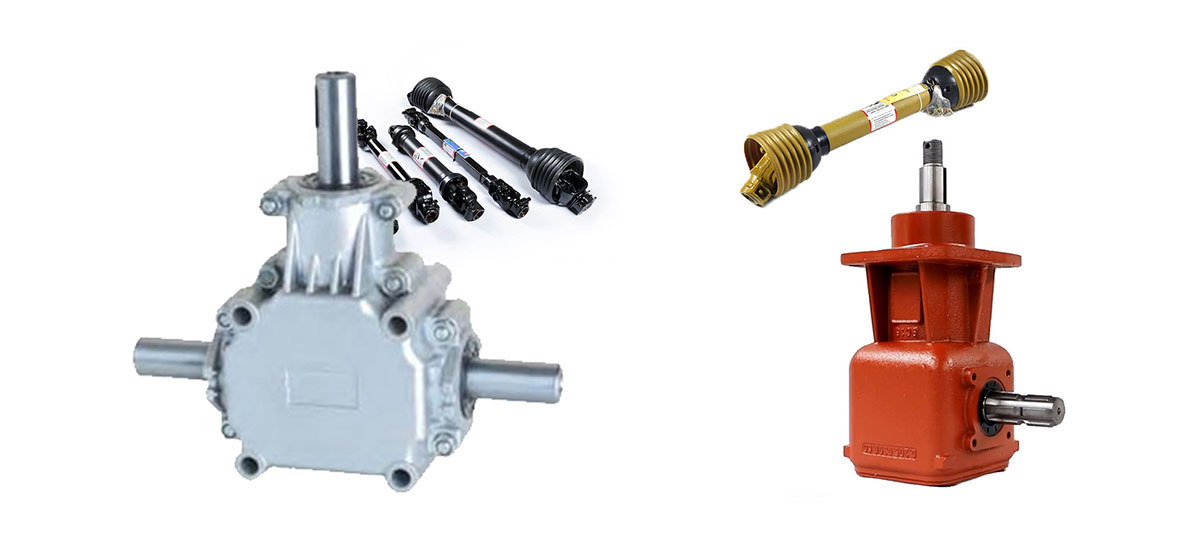
A high-performance driveline is only one half of the mechanical equation. To achieve seamless kinetic transfer, the PTO shaft must interface with robust, precision-engineered agricultural gearboxes. Ever-Power is a leading global manufacturer of comprehensive transmission systems.
Baler Main Drive Gearboxes (T-Box / Bevel Gear)
The immense power delivered by our heavy-duty PTO shafts is received by the baler’s primary input gearbox. For large square balers, we manufacture massive T-box configurations utilizing spiral bevel gears made from carburized 20CrMnTi steel. These gears are ground to a precision grade of DIN 6, ensuring minimal backlash and extremely low noise under load.
When our G6.3 dynamically balanced driveline meets our precision gearbox, bearing life on the input shaft increases by up to 60%. The symbiotic engineering ensures that shock loads not absorbed by the slip clutch are easily dispersed by the gearbox housing’s nodular cast-iron architecture.
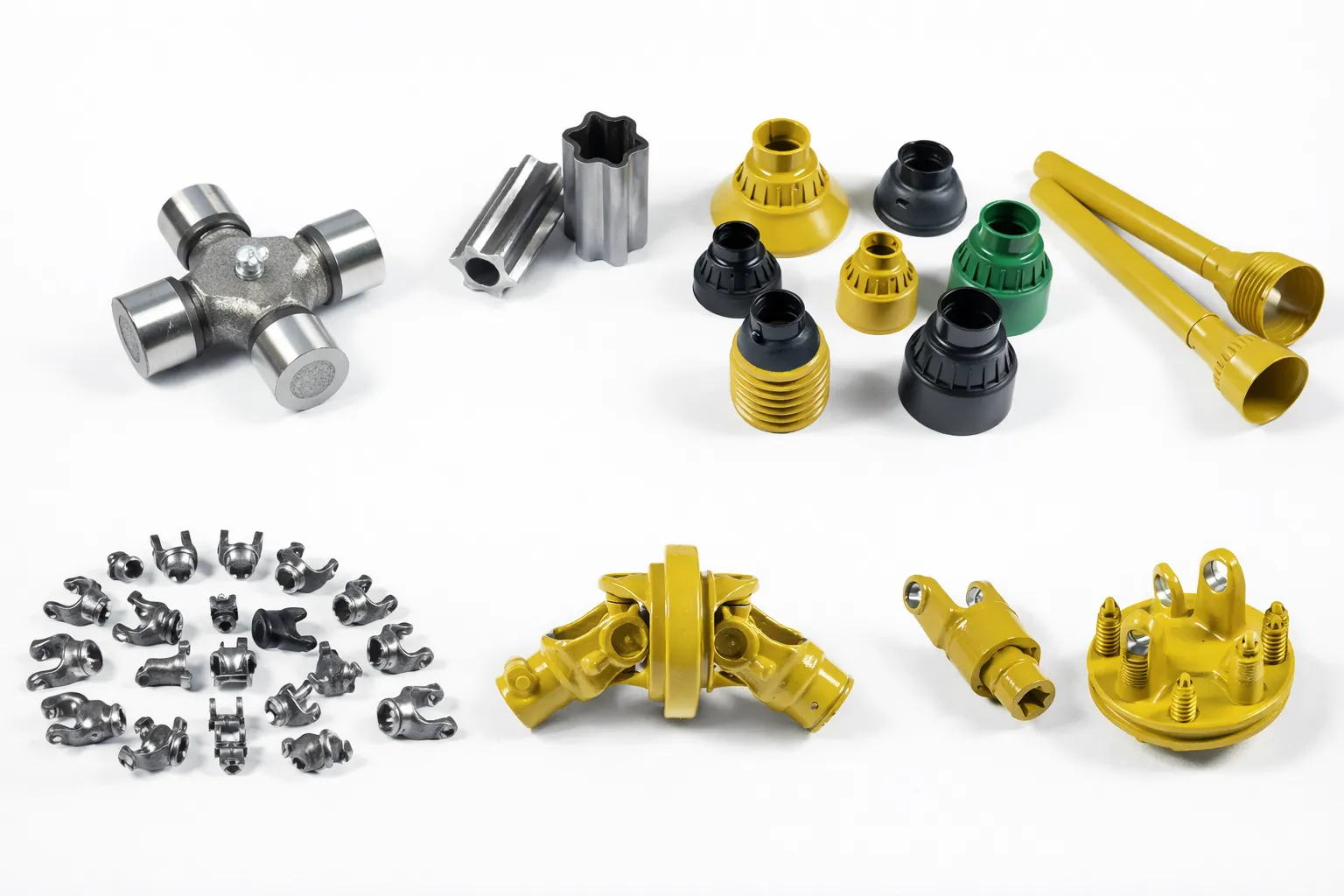
Ancillary Transmission Components
Beyond primary drivelines and gearboxes, the complex kinematics of a haybaler—from the pickup reel to the knotter mechanism—rely on secondary power distribution.
- Sprockets & Chains: For pickup reel drives, we produce induction-hardened roller chains and C45 steel sprockets designed to resist the abrasive nature of crop dust.
- Pulleys & Belts: Heavy-duty v-belt pulleys for secondary fan drives or auxiliary pumps, statically and dynamically balanced.
- Custom Splined Shafts: Internal gearbox shafts and secondary drivelines customized to exact OEM dimensions.
Deploy Unyielding Power in Your Agricultural Fleet
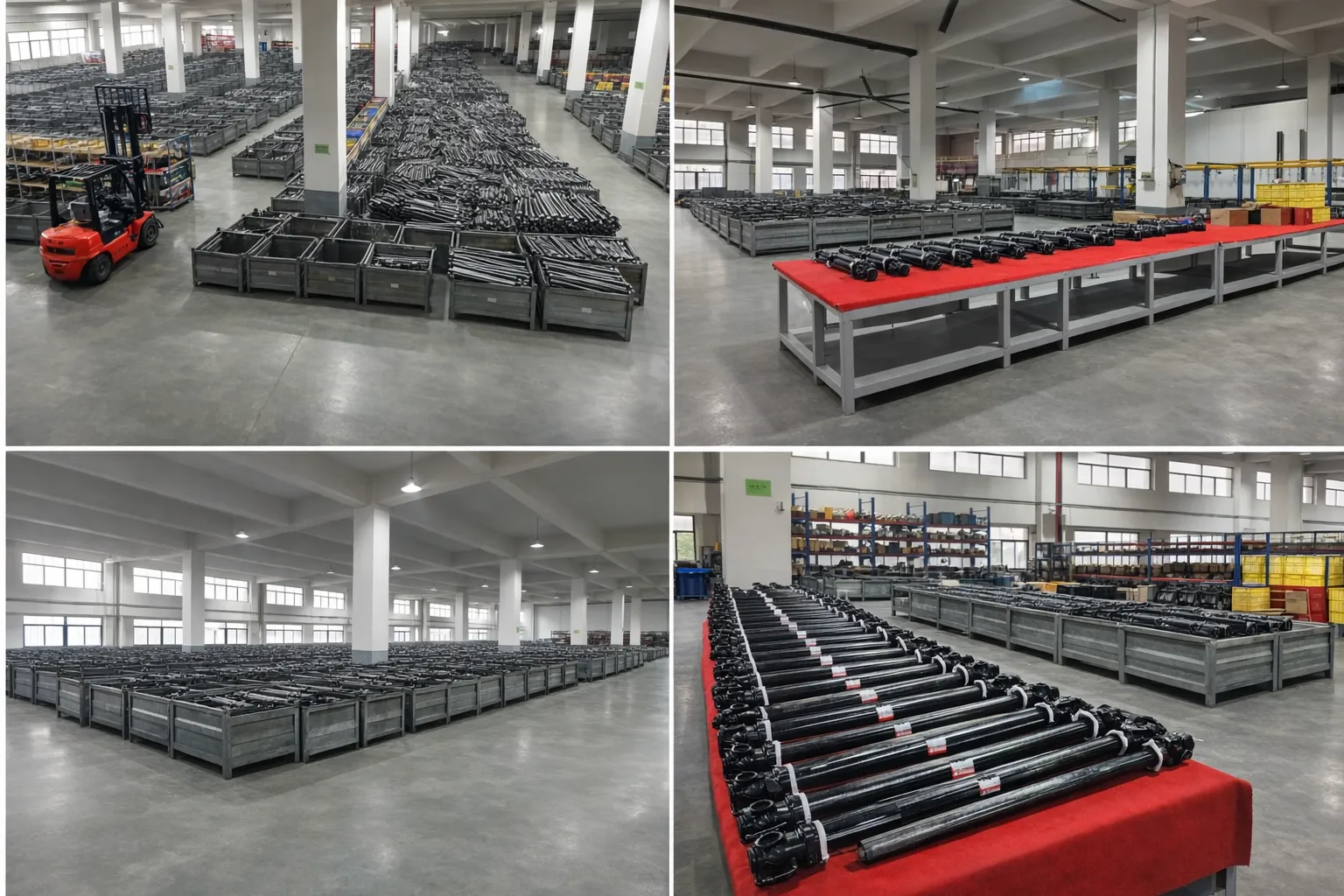
Ever-Power does not just supply standard parts; we engineer kinetic solutions. With over two decades of metallurgical expertise, state-of-the-art CNC machining, and rigorous ISO 9001:2015 quality control protocols, we guarantee driveline architecture that withstands the most brutal environments.
Require non-standard dimensions? We excel in OEM/ODM customization. Provide your technical drawings, and our engineering team will fabricate exact-spec prototypes.
REQUEST TECHNICAL QUOTATION & ENGINEERING CONSULTATION
Visit our Homepage for our complete driveline catalog.