Heavy-Duty PTO Shafts for Sugar Beet Harvesters: Australian Extreme Condition Solutions
Engineered for extreme torque density, abrasive red clay, and continuous high-load harvesting. Maximize your yield with our resilient tractor PTO shaft systems.
Core Technology Quick Read: The Powertrain Heart of Root Crop Harvesting
Within the domain of agricultural machinery, the sugar beet harvester represents the absolute apex of powertrain stress. Unlike standard mowers or tillers, pulling, cleaning, and conveying thousands of tons of mud-laden sugar beets generates extreme, unpredictable shock loads. A standard drive shaft will simply twist and fail under these dynamic constraints. Our heavy-duty pto drive shaft assemblies are exclusively forged from specialized ASTM 1144 and 42CrMo alloy steel. By integrating Wide-Angle Constant Velocity (CV) Joints, our systems allow harvesting equipment to execute continuous, full-power turns at up to 80 degrees at the headlands, ensuring absolute torque stability and zero disruptive vibrations during the critical harvesting window.
Engineer’s Field Log: Overcoming Torque Decay in Victoria’s Red Clay
“During my 20 years of servicing heavy agricultural contractors across the globe, the soil conditions in Victoria and Queensland, Australia, have always presented a unique nightmare for mechanical power transmission. In 2014, we spent three weeks at a major farm near Melbourne. The traditional PTO shafts they were using kept suffering from catastrophic torsional sheer because the sticky red clay, mixed with rocks, would instantly jam the front topper and lifting wheels. The sudden zero-RPM stop sent a destructive shockwave back to the tractor. Based on this extensive 10-year factory case and field observation, the Ever-power engineering team completely redesigned the multi-plate slip clutch integration and thickened the star profile tube wall by an additional 1.5mm. When we tested the new prototype the following season, even when encountering a massive 4500 Nm stalling impact from a hidden boulder, our shaft’s friction discs slipped with mathematical precision, perfectly protecting the main tractor gearbox. It ran faultlessly for over 1500 hours that season. This isn’t just theory; it is battle-tested durability.”
Principles: How the PTO Shaft Drives the Sugar Beet Harvester
In both trailed and self-propelled sugar beet harvesting systems, the tractor pto shaft is the indispensable conduit transferring mechanical kinetic energy from the tractor’s engine to the implement’s primary input gearbox. From this central distribution node, power is split into multiple highly demanding sub-systems:
1. The Defoliator/Topper Drive
This section requires rapid, continuous RPM to cleanly sever the beet greens. The shaft here experiences high-frequency rotational stress and must maintain strict dynamic balancing to prevent harmonic resonance from tearing the bearing mounts apart.
2. The Lifting Shares & Opposed Rotors
The most brutal phase. The PTO power forces the lifting shares deep into compacted soil to extract the root. This is where peak torque limits are tested daily. A high torsional yield profile tube (like our six-lobe star shape) is mandatory here.
3. Cleaning Turbines & Conveyor Webs
These massive rotating masses carry immense kinetic inertia. When the tractor PTO is disengaged, this inertia must be managed. Overrunning clutches built into our PTO shafts allow the turbines to safely spin down, preventing reverse torque from destroying the tractor’s PTO brake.
Queensland and Victoria Extreme Condition Field Study & Compliance
The geographic diversity of Australia dictates that a one-size-fits-all approach to agricultural power transmission is fundamentally flawed. Through rigorous field analysis, we have adapted our engineering parameters to meet the specific environmental and legislative demands of the Australian continent.
- ✓
Queensland’s Tropical UV Radiation: In the northern agricultural belts, the extreme ultraviolet index rapidly degrades standard plastics. A brittle safety guard is a severe safety hazard. Our pto shaft supplier protocols mandate the use of high-density polyethylene (HDPE) infused with specialized anti-UV and anti-oxidation additives, ensuring the guarding system remains flexible and structurally sound even after five years of relentless sun exposure. - ✓
Tasmania and Victoria’s Abrasive Mud: Harvesting in wet conditions forces mud and grit into every moving crevice. Our cross journal bearings (U-joints) feature an advanced triple-lip nitrile rubber sealing system. This prevents microscopic silica particles from breaching the bearing cups and scoring the needle rollers, dramatically extending the lubrication interval to 250 hours. - ✓
Safe Work Australia / AS/NZS Compliance: Australian agricultural safety laws are among the strictest globally. Operating an implement with an exposed rotating shaft is heavily penalized. All Ever-power shafts are homologated to ISO 5674 and AS/NZS standards, featuring fully overlapping guard tubes, robust anti-rotation chains, and clearly molded safety pictograms to ensure full regulatory compliance.
Engineering Specification for Sugar Beet Harvester PTOs
The following data matrix outlines the exact metallurgical, geometric, and dynamic specifications that dictate the performance of our Series 8 and Series 9 heavy-duty drive shafts. These figures are derived from exhaustive dynamometer testing.
| Technical Parameter | Standard Baseline Value | Customization Range / Tolerance |
|---|---|---|
| Dynamic Operating Torque (@ 540 RPM) | 2,200 Nm (Series 8) | Up to 3,800 Nm for self-propelled units |
| Peak Shock Load Tolerance | 5,100 Nm | Max tested: 7,500 Nm (Alloy upgrade) |
| Tractor Side Yoke Spline | 1-3/8″ 6-Spline or 21-Spline (ASAE) | 1-3/4″ 20-Spline heavy-duty option |
| Implement Side Connection | 1-3/4″ 6-Spline with Pinch Bolt | Flange yoke, Keyway plain bore, Shear bolt |
| Max Constant Velocity (CV) Deflection | 80° Wide-Angle articulation | 50° standard to 80° CV joints |
| Cross Journal (U-Joint) Dimensions | 34.9 mm x 106 mm (Precision ground) | Custom sizes up to 41 mm x 118 mm |
| Telescopic Tube Profile | Lemon / Hexagonal / Star | Rilsan coated splined shaft for low friction |
| Inner/Outer Tube Wall Thickness | 4.5 mm (Inner) / 4.0 mm (Outer) | Up to 6.0 mm for extreme applications |
| Metallurgical Grade (Yokes) | Closed-die forged 45# Steel | Forged 40Cr / 42CrMo Quenched & Tempered |
| Safety Device / Overload Protection | 4-Disc Friction Slip Clutch (FF) | Cam clutch, Overrunning clutch, Shear bolt |
| Dynamic Balancing Grade | ISO 1940 G6.3 | G2.5 available for high RPM (+1000) |
| Surface Corrosion Resistance | Powder-coated (500h Salt Spray Test) | Zinc plated, Black oxide, Marine epoxy |
| Safety Guard Material | UV-Resistant HDPE Polymer | Extreme cold/heat resistant specialized blends |
| Maintenance Lubrication Interval | Every 50 Operating Hours | 250 Hour Extended Life (W-series seals) |
| Minimum Compressed Length (Lz) | 1010 mm (Cross to Cross) | 600 mm to 2000 mm tailored to chassis |
| Maximum Telescopic Stroke | 350 mm | Proportional to minimum length |
| Profile Overlap Requirement | Minimum 1/3 of total tube length | Extended engagement for deep articulation |
| Anti-Rotation Chains | Standard dual-end high tensile | Quick-release carabiner clips |
| Operating Temperature Range | -30°C to +85°C | -45°C Arctic grease / High-temp configurations |
| Tensile Strength of Tube | 680 MPa | ≥ 850 MPa (Alloy variant) |
| Torsional Yield Point | > 5,500 Nm | Reinforced collar configurations available |
| Yoke Manufacturing Process | Hot Forged, CNC Milled | Induction hardened spline teeth (50-55 HRC) |
| U-Joint Sealing Technology | Triple-lip NBR Dust Seal | Viton (FKM) for high chemical/heat resistance |
| Acoustic Emission / Noise Level | < 78 dB under full load | Acoustically damped guard bearings |
| Locking Mechanism | Quick-Disconnect Push Pin | Slide collar, Tapered pin, Clamp bolt |
| Clutch Friction Disc Material | Asbestos-free organic composite | Sintered bronze for extreme heat dissipation |
| Yoke Ear Rigidity | Finite Element Analysis (FEA) verified | Thickened rib structures for shock mitigation |
| Global Certification Standards | CE, ISO 5673-1, AS/NZS | Can provide specific regional safety testing docs |
The Ever-power Engineering Superiority
When dealing with industrial-scale sugar beet yields, downtime is calculated in thousands of dollars per hour. Our design philosophy eliminates weak links:
- Closed-Die Forged Yokes: Unlike brittle cast iron, our forging process ensures the metallic grain flow follows the contour of the yoke ears. This results in a 40% higher fatigue resistance against torsional snapping.
- Precision Calibrated Slip Clutches: Our multi-plate friction clutches allow the exact slipping torque to be dialed in via spring compression, providing a repeatable safety net that shear bolts simply cannot offer.
- Advanced Dynamic Balancing: Every shaft assembly undergoes high-speed computerized balancing. This prevents high-frequency vibrations from destroying the expensive input seals and bearings on the harvester’s gearbox.
The Hidden Costs of Inferior PTO Shafts
The market is flooded with low-cost aftermarket shafts that pose severe operational and safety risks when applied to heavy machinery:
- Porosity in Cast Yokes: Cheap shafts often use sand-cast yokes containing microscopic air bubbles. Under the shock load of a jammed beet elevator, these shatter instantly like glass.
- Lethal Guarding Failures: Using recycled, low-grade plastics for the safety guard means they become brittle in the sun within months. A shattered guard exposes the spinning shaft, presenting an extreme entanglement hazard.
- Imprecise Machining: Loose tolerances on the splines lead to “spline slop” and rapid fretting wear, eventually stripping the tractor’s PTO output shaft entirely.

Universal Brand Compatibility and Replacement Component
Supply chain delays for original equipment manufacturer (OEM) parts can cripple a harvest. Our meticulously engineered pto shaft portfolio is designed to conform to international dimensional standards (such as European metric profile tubes and North American ASAE spline specifications), allowing for seamless, drop-in replacement across a mixed fleet of agricultural machinery.
Legal & Compatibility Disclaimer: EVER-POWER operates as an entirely independent manufacturer of premium power transmission components. Any reference made on this webpage to original equipment manufacturers (OEMs), including but not limited to Comer Industries™, GKN Walterscheid™, Bondioli & Pavesi™, Weasler™, or Bare-Co™, as well as their respective part numbers or series designations, is strictly for technical reference, dimension matching, and cross-reference purposes only. We do not claim any affiliation, endorsement, or sponsorship by these trademark holders. Our products are rigorously engineered aftermarket alternatives designed for perfect technical compatibility, avoiding any trademark infringement.
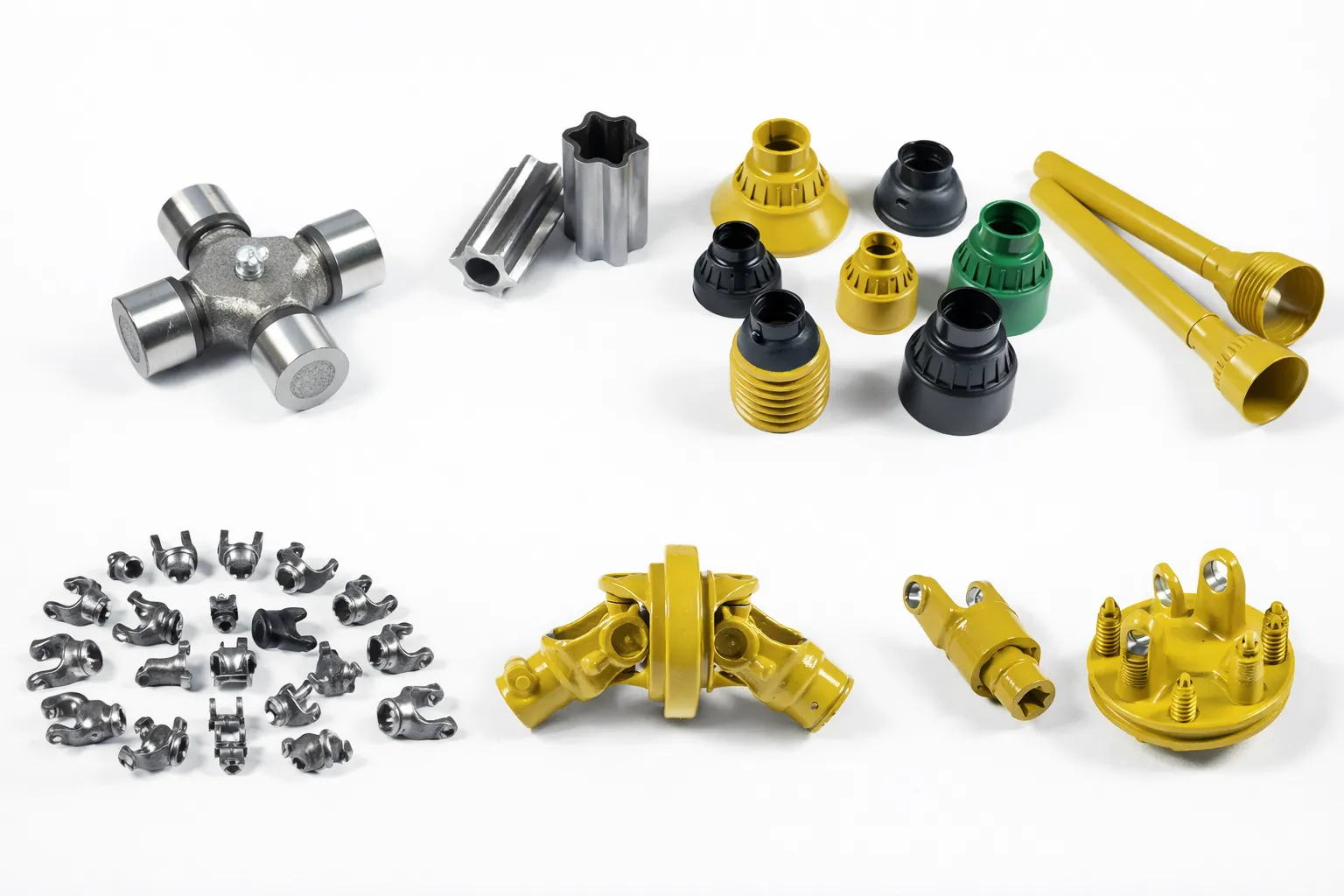
Whether your fleet requires a replacement for a heavy-duty GKN Walterscheid™ W-Series shaft with an overrunning clutch, or you need to match the specific triangular tube profile of a Comer Industries™ T-Series assembly powering a beet defoliator, we manufacture the exact geometric equivalent. Furthermore, we maintain a comprehensive inventory of serviceable spare parts:
Forged crosses featuring centrally located zerk fittings for safe, accessible greasing, complete with high-tension circlips.
Advanced, non-asbestos composite friction linings designed to withstand extreme thermal loads during prolonged slippage.
Complete bell and tube shield assemblies featuring integrated, self-lubricating nylon bearing rings and sturdy retention chains.
Metallurgically tested Grade 8.8 and 10.9 bolts engineered to snap at exact torque thresholds, safeguarding your gearboxes.
Powertrain Selection Guide
To prevent catastrophic mechanical failure and optimize transmission efficiency, procurement officers and field technicians must adhere to a strict logical sequence when specifying a replacement heavy-duty driveline for root crop machinery:
| Phase | Critical Parameter Identification | Engineering Mandates & Risk Avoidance |
|---|---|---|
| Step 1 | Calculate Tractor & Implement Horsepower (HP/kW) | Harvesters requiring over 150 HP input absolutely mandate a Series 8 or Series 9 classification. Selecting an undersized series (e.g., Series 6) will result in immediate bearing vaporization under peak load. |
| Step 2 | Determine Compressed & Extended Working Lengths (Lz) | Measure end-to-end when the implement is lifted to its closest mathematical point to the tractor. You must leave a minimum of 50mm clearance before the tubes bottom out, or the resulting thrust will shatter the tractor’s rear casing. |
| Step 3 | Map the Input and Output Yoke Interfaces | Precisely count the splines and measure the outer diameter (e.g., 1-3/8″ 21-spline). Verify if the implement side utilizes a keyed plain bore with a setscrew or a bolted flange connection. |
| Step 4 | Evaluate Constant Velocity (CV) Requirements | If the operator engages in sharp, under-power headland turns exceeding a 35-degree offset, a single or double 80° Wide-Angle CV joint is structurally mandatory to prevent driveline shudder and premature universal joint failure. |
| Step 5 | Specify the Overload Protection Mechanism | For digging implements prone to rock jams, a multi-disc friction clutch is superior. For driving massive cooling fans or cleaning turbines with high momentum, an overrunning clutch (freewheel) must be integrated. |
Specific Installation and Calibration Protocol for Heavy Machinery
Because the tractor pto shaft rotates at either 540 or 1000 RPM while transmitting immense torque, any deviation in alignment, length, or phasing will induce devastating kinetic vibrations or explosive structural failure. Maintenance personnel must execute the following protocol strictly:
- Spline Preparation and Anti-Seize Application: Utilizing a wire brush, meticulously eliminate all corrosion, dried mud, and debris from the tractor’s PTO stub and the implement’s input shaft. Apply a thin, uniform coat of high-pressure anti-seize molybdenum compound to facilitate future removal and prevent galling.
- Kinematic Length Verification and Trimming: Separate the shaft into its two halves. Attach one half to the tractor and the other to the implement. Hold them parallel. At the shortest operational distance (maximum compression), the tube ends must clear the opposite universal joint yokes by an absolute minimum of 40mm. If trimming is required, mathematically calculate the excess, and cut exactly the same amount from the inner steel tube, the outer steel tube, and both plastic guard tubes. Deburr all edges meticulously.
- Rotational Phasing Alignment: When reassembling non-splined profile tubes (such as Lemon or Star profiles), you must guarantee that the inner yokes on both ends of the complete shaft are perfectly aligned on the same geometric plane (Zero Phase Angle). Misalignment will cause unequal angular velocity, resulting in a severe, machine-destroying vibration known as torsional oscillation.
- Positive Locking Engagement: Slide the yokes onto the splined shafts. Fully depress the quick-release pin or slide collar. Once positioned over the locking groove, release the mechanism and forcefully push and pull the yoke back and forth to guarantee the locking pin has audibly seated and locked into the annular groove.
- Safety Guard Restraint Configuration: Anchor the anti-rotation chains affixed to the safety guards to secure, non-rotating points on both the tractor chassis and the implement. The chains must possess enough slack to allow for the full lifting and articulation arc of the machinery, yet be taught enough to prevent the plastic guard from rotating with the inner steel shaft.
Driveline Operational Troubleshooting Diagnostics
During the critical harvest window, an immobilized machine translates to severe financial penalty. This diagnostic matrix decodes common mechanical symptoms, providing the underlying physics and immediate field resolution strategies:
Case Studies: Validating Durability Across Australia
Our driveline components are perpetually subjected to the harshest real-world validation in the soils of Oceania. Below are verified engineering feedback logs from prominent agricultural zones:
📍 Brisbane, Queensland (QLD) – High-Capacity Self-Propelled Harvester Refit
Client Pain Point: An imported European harvester utilized standard PTO shafts whose plastic guards completely disintegrated after one season under the intense Queensland UV index, drawing severe warnings from local workplace safety inspectors.
Ever-power Solution: We retrofitted the fleet with our extreme UV-stabilized wide-angle tractor pto shaft, coupled with a 6-disc high-capacity thermal friction clutch.
Client Feedback: “This shaft operates flawlessly even under a 40°C afternoon sun. The safety guards survived two full harvesting seasons without a single micro-crack. This is exactly the kind of robust engineering we require.”
📍 Melbourne, Victoria (VIC) – Defending Against Submerged Boulder Jams
Client Pain Point: Following heavy rains, the sticky red soil hid large granite rocks. When these entered the lifting shares, the sudden stop snapped OEM shear bolts several times a day, devastating operational efficiency.
Ever-power Solution: We supplied a customized Series 8 driveline featuring an automatic reset cam clutch (radial pin clutch) calibrated to slip at precisely 3200 Nm and automatically re-engage once the jam cleared.
Client Feedback: “The auto-reset mechanism saved us countless hours of downtime in the mud. No more hammering out broken shear bolts in the rain. The solid forged yokes handle the immense shock loads effortlessly.”
📍 Perth, Western Australia (WA) – Extensive Broadacre Continuous Turning
Client Pain Point: Massive broadacre fields required harvesters to execute continuous, powered headland turns to maintain efficiency. Standard U-joints were chattering violently and failing due to extreme working angles.
Ever-power Solution: Deployment of a Double Wide-Angle (80° CV) transmission shaft, allowing smooth power delivery during acute turns without needing to disengage the PTO.
Client Feedback: “We now maintain an uninterrupted turning radius up to 80 degrees at full 1000 PTO RPM. The complete elimination of driveline shudder has noticeably reduced the wear on our tractor’s rear differential.”
📍 Sydney Rural, New South Wales (NSW) – Mixed Fleet Part Standardization
Client Pain Point: A large contracting firm operated 14 different harvesters of varying brands, causing an absolute logistical nightmare regarding spare parts inventory and cross-compatibility.
Ever-power Solution: We audited their fleet and standardized all primary drive inputs to our universal 1-3/8″ 6-spline Series 8 architecture, ensuring 100% interchangeability of cross journals, tubes, and guards.
Client Feedback: “Standardizing with their universal, highly engineered replacement parts slashed our spare parts inventory overhead by 35%. A single cross kit now services our entire mixed fleet.”
📍 Adelaide, South Australia (SA) – Eradicating High-Speed Conveyor Resonance
Client Pain Point: A long-reach lateral transfer conveyor was being driven by an unbalanced shaft, creating a harmonic resonance that violently shook the entire chassis of the harvester at operating speeds.
Ever-power Solution: We engineered a specialized rigid-tube shaft featuring a 5.5mm wall thickness and performed a high-precision dynamic balancing procedure to ISO G2.5 standards.
Client Feedback: “The high-frequency vibration issue is completely eradicated. The precision dynamic balancing is genuinely spot-on, allowing the entire conveyor web system to run exceptionally quietly and smoothly.”
Expert Knowledge Base
For those optimizing their machinery for peak season, understanding the nuanced engineering of power transmission is crucial.
1. Should I specify a 540 RPM or a 1000 RPM system for my heavy root crop machinery?
This is dictated entirely by your tractor’s output capabilities and the gear reduction ratio of the implement’s gearbox. However, from an engineering standpoint, high-horsepower applications strongly favor 1000 RPM. Physics dictates that to transmit the exact same amount of horsepower, a 1000 RPM system generates roughly half the twisting torque compared to a 540 RPM system. This significantly lowers the sheer stress on the U-joints and splines, allowing for lighter, yet more durable driveline designs.
2. How do I precisely identify when my friction slip clutch requires a complete rebuild?
If you experience the clutch slipping excessively under normal, unobstructed harvesting loads—even after you have torqued the compression springs to the manufacturer’s maximum specification—it is failing. Upon disassembly, measure the friction discs with calipers. If their thickness has degraded below 60% of the original specification, or if the surface exhibits a shiny, glass-like ‘glazed’ texture due to extreme thermal carbonization, the entire disc pack must be replaced immediately.
3. What is the maximum articulation limit of your Wide-Angle CV Joints under full power?
Our heavy-duty Constant Velocity (CV) joint architecture is meticulously designed to permit brief articulation angles up to 80 degrees (typically utilized during sharp headland maneuvers) while maintaining 100% power transmission. Critically, the double-yoke centering mechanism ensures that rotational velocity remains perfectly constant across the joint, entirely eliminating the destructive secondary vibrations associated with standard single U-joints at high angles.
4. When modifying the shaft length, why is it mandatory to trim the plastic guard equally with the steel tubes?
This is a critical structural requirement. If the telescopic steel tubes are shortened but the plastic guard tubes are left long, the plastic guard will bottom out against itself when the implement is lifted. This will instantly crush the safety guard bearings and destroy the protective shield, rendering the equipment unsafe and illegal to operate.
5. What specific mechanical role does an Overrunning Clutch play in harvester systems?
An overrunning clutch (often utilizing a ratchet or sprag mechanism) acts as a one-way mechanical diode. Massive components like cleaning turbines possess immense kinetic inertia. If the tractor operator suddenly throttles down or disengages the PTO, that massive spinning weight wants to keep moving. Without an overrunning clutch, that reverse kinetic energy is violently driven backward through the shaft directly into the tractor’s internal PTO braking mechanism, often shattering it. The overrunning clutch simply allows the implement to safely “freewheel” to a gentle stop.
6. From an engineering perspective, why is the ‘Six-Lobe Star’ profile tube superior to standard lemon profiles?
The mechanical advantage lies in surface area and stress distribution. A six-lobe star profile offers significantly more contact surface between the inner and outer tubes compared to a two-point lemon profile. When subjected to the immense shock loads typical of root harvesting, the star profile distributes the torsional shear stress across six planes rather than two, practically eliminating the risk of the tubes twisting and permanently seizing together under load.
7. What is the rigorous lubrication protocol for the universal joint cross journals?
In highly abrasive, dust-and-mud intensive environments, strict adherence to a 50-hour lubrication interval is required. You must utilize a high-quality Extreme Pressure (EP) lithium-based grease. Crucially, you must pump grease into the zerk fitting until you physically observe clean, new grease purging slightly from all four rubber bearing seals. This purging action physically expels microscopic dirt particles and moisture that have breached the outer lip, saving the needle rollers inside.
8. Why do brand-new friction clutches require a ‘burn-in’ or ‘run-in’ procedure before heavy use?
During overseas transit or extended warehouse storage, microscopic oxidation can cause the friction discs to bond tightly to the metal pressure plates, creating an artificially high break-away torque. Before deploying the machine, operators must loosen the spring tension, engage the PTO under minimal load to force the clutch to slip for 3 to 5 seconds. This actions polishes the mating surfaces, guaranteeing that the clutch will slip exactly at its mathematical torque threshold when a real jam occurs.
9. Can I substitute a snapped shear bolt with a standard high-tensile hardware bolt in an emergency?
Absolutely not. A shear bolt is not merely a fastener; it is a highly calibrated mechanical fuse. Its metallurgical composition and specifically machined groove (if present) are calculated to snap at an exact torsional limit. Replacing a Grade 8.8 shear bolt with a stronger Grade 12.9 hardware store bolt means the bolt will survive the impact, but the $10,000 gearbox behind it will explode instead. Always stock exact OEM-spec replacement shear bolts.
10. How can an operator physically diagnose a U-joint that is nearing catastrophic failure?
With the machine off, grasp the main tube firmly with one hand, and the heavy forged yoke with the other. Apply forceful, opposing rotational twisting motions. If you perceive even a millimeter of mechanical ‘slop’, clicking, or tactile play, the needle bearings have disintegrated. Furthermore, if you observe the area around the bearing caps exhibiting a rusty, reddish powder (known in engineering as ‘fretting dust’), the joint has run completely dry and failure is imminent.
Agricultural Gearboxes and Driveline Accessories
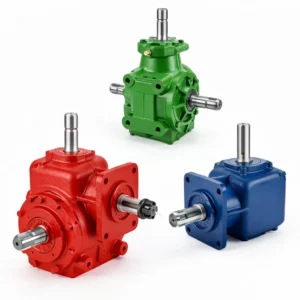
Power transmission does not conclude at the implement yoke. A resilient driveline is a continuous, unbroken chain of torque management. The absolute finest drive shaft in the world is rendered useless if it inputs its power into a structurally compromised gear reduction unit. At Ever-power, we engineer the entire kinetic pathway, providing a holistic, perfectly matched ecosystem of heavy-duty powertrain components designed specifically for the extreme shock loads of modern agriculture.
State-of-the-Art Manufacturing Infrastructure
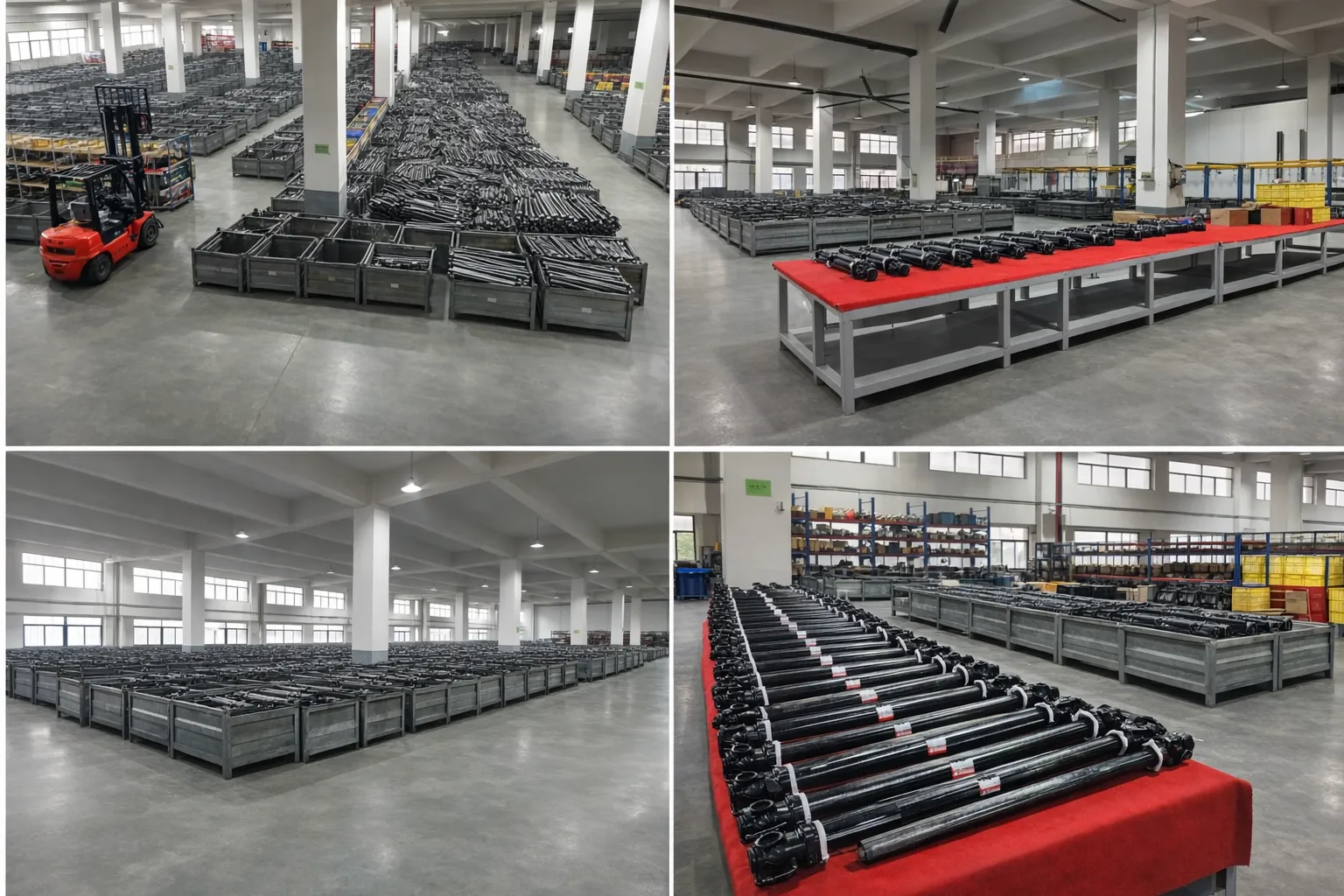
Our 20,000 square meter intelligent manufacturing facility combines heavy industrial forging capabilities with micron-level CNC precision, ensuring every shaft meets exacting global tolerances.